
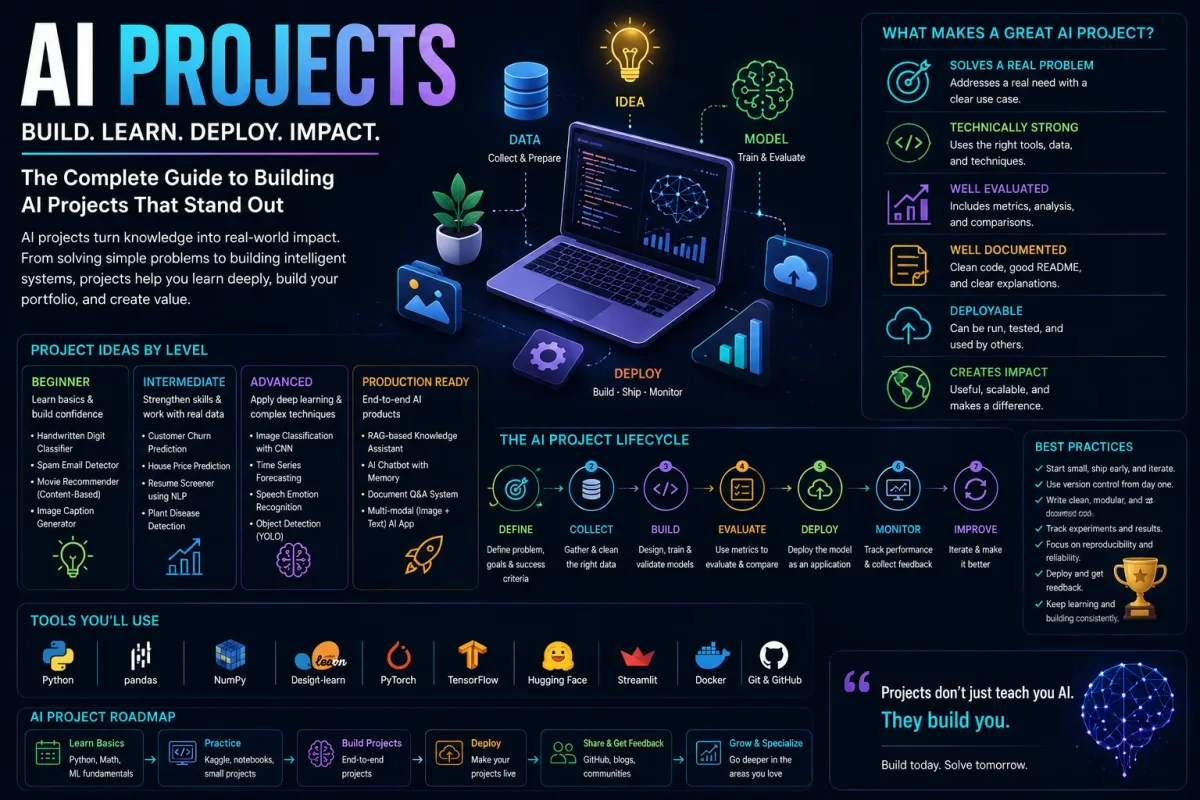
Learning AI from courses, books, and tutorials gives you knowledge.
Building projects turns that knowledge into engineering skill.
This distinction matters.
You can understand linear regression and still be unable to build a useful machine learning application. You can understand transformers and still struggle to ship an LLM product. You can complete ten tutorials and still have a GitHub profile that tells an employer very little about what you can actually build.
A strong AI project should do more than prove that you can import a library.
It should show that you can:
- define a real problem
- work with data
- choose an appropriate approach
- build a system
- evaluate results
- handle failure cases
- document your decisions
- deploy something useful
This guide is designed to help you do exactly that.
It covers AI project ideas from beginner to advanced, explains how to choose the right project, shows how projects should evolve as your skills improve, and gives you a framework for turning projects into a strong AI engineering portfolio.
What Makes an AI Project Good?
There are thousands of AI project ideas online.
Most are not worth building.
A good project has four characteristics:
Real Problem
    +
Interesting Technical Work
    +
Measurable Results
    +
Useful Engineering
For example, “Build a chatbot” is too vague.
A much stronger project is:
Build a documentation assistant that answers questions from a software project’s internal documentation, cites the source passages it used, evaluates retrieval quality, and runs as a deployed API.
Now you have a problem, an architecture, measurable components, and an engineering story.
That distinction is important when you’re building a portfolio.
Projects Are Part of the Learning Process
Projects should not come only after you “finish learning AI.”
That rarely works.
A better cycle is:
Learn
  ↓
Build
  ↓
Get Stuck
  ↓
Study What You Need
  ↓
Improve
  ↓
Measure
  ↓
Build Again
Getting stuck is useful when it reveals a missing concept.
For example:
- You learn regression.
- You build a prediction system.
- Your model performs badly.
- You investigate feature scaling and data leakage.
- You improve the pipeline.
- You understand those topics much more deeply.
The project becomes part of the curriculum.
The Four Levels of AI Projects
A useful way to organize your portfolio is:
Beginner
   ↓
Intermediate
   ↓
Advanced
   ↓
Production
The difference is not simply how complicated the model is.
The difference is how much of the system you can own.
Beginner
Focus on:
- Python
- data
- basic ML
- visualization
- simple evaluation
Intermediate
Add:
- stronger models
- APIs
- deployment
- databases
- better evaluation
- more realistic datasets
Advanced
Add:
- deep learning
- LLMs
- RAG
- agents
- model optimization
- asynchronous workflows
- distributed components
Production
Add:
- authentication
- monitoring
- testing
- CI/CD
- observability
- reliability
- security
- cost control
This progression is far more useful than judging projects only by whether they use a “fancy” model.
Beginner AI Projects
Beginner projects should teach you the fundamentals of data, models, evaluation, and problem solving.
Do not underestimate simple projects.
A small, well-understood project is much better than a large project you cannot explain.
1. House Price Prediction
Difficulty: Beginner
Build a regression model that predicts house prices from features such as:
- area
- number of bedrooms
- location
- age
- amenities
Skills
- pandas
- NumPy
- data cleaning
- visualization
- regression
- MAE / RMSE
- feature engineering
What to learn
The real goal is not predicting house prices.
It is learning the complete regression workflow:
Dataset
 ↓
Exploration
 ↓
Cleaning
 ↓
Features
 ↓
Train/Test Split
 ↓
Model
 ↓
Evaluation
How to improve it
After the baseline model:
- compare multiple regression algorithms
- inspect residuals
- add feature engineering
- use cross-validation
- build a small prediction API
2. Student Performance Predictor
Difficulty: Beginner
Predict an academic outcome from factors such as study time, attendance, previous scores, and other available features.
Skills
- regression
- data visualization
- feature analysis
- model evaluation
Better version
Don’t stop at prediction.
Add a simple dashboard showing:
- prediction
- important features
- confidence or uncertainty where appropriate
- model limitations
That turns a notebook into an application.
3. Spam Email Classifier
Difficulty: Beginner
Build a classifier that predicts whether a message is spam.
Skills
- text preprocessing
- TF-IDF
- classification
- precision
- recall
- confusion matrix
Why it’s useful
You get your first practical introduction to NLP without immediately needing a deep learning model.
4. Sentiment Analysis
Difficulty: Beginner
Classify reviews or comments as positive, negative, or another predefined sentiment category.
Start with
- TF-IDF
- logistic regression
- Naive Bayes
Then improve it
Compare the classical ML baseline with a pretrained transformer.
This gives you a clean project showing the progression from classical NLP to modern deep learning.
5. Image Classifier
Difficulty: Beginner → Intermediate
Train a classifier to distinguish between a small number of image categories.
For example:
cat
dog
bird
Start with a simple model.
Then move to transfer learning.
What it teaches
- image preprocessing
- train/validation split
- neural networks
- metrics
- confusion matrices
- overfitting
PyTorch’s official beginner tutorials provide a practical path for building and training neural networks, which makes it a suitable framework for this kind of project. (PyTorch — Learn the Basics)
Intermediate AI Projects
Once you understand basic ML workflows, stop building projects that look like classroom exercises.
Start solving more realistic problems.
6. Customer Churn Prediction
Difficulty: Intermediate
Predict whether a customer is likely to leave a service.
Add real engineering
Build:
Data Pipeline
   ↓
Model
   ↓
Evaluation
   ↓
FastAPI
   ↓
Web Interface
Measure
Don’t report only accuracy.
Include:
- precision
- recall
- F1
- ROC-AUC
- confusion matrix
Then discuss the business trade-offs.
7. Recommendation System
Difficulty: Intermediate
Build a system that recommends:
- movies
- books
- courses
- products
- articles
Start with content-based recommendations.
Then experiment with collaborative filtering.
Strong portfolio improvement
Create a public demo where someone can choose an item and receive recommendations.
Now the project demonstrates both ML and product engineering.
8. Fraud Detection System
Difficulty: Intermediate
Build a classifier or anomaly-detection system for suspicious transactions.
This is a good project because class imbalance becomes a real issue.
You need to think about:
- precision vs recall
- false positives
- false negatives
- threshold selection
- data drift
This makes the project much more realistic than a balanced classroom dataset.
9. Document Search Engine
Difficulty: Intermediate
Build a search system for documents.
Start with keyword search.
Then add semantic search using embeddings.
The progression becomes:
Keyword Search
     ↓
TF-IDF
     ↓
Embeddings
     ↓
Semantic Search
     ↓
Hybrid Search
This is an excellent bridge into RAG.
10. Resume Analyzer
Difficulty: Intermediate
Build a system that compares a resume against a job description.
Possible output:
Skill Match: 78%
Missing Skills:
- Docker
- SQL
- PyTorch

Relevant Experience:
...
Important
Don’t make unverified claims such as:
“This resume will get you an interview.”
Instead, frame it as an analysis tool.
Evaluate it using a labeled test set and clearly document limitations.
11. OCR Document Pipeline
Difficulty: Intermediate
Build a system that extracts structured information from documents.
Example:
PDF / Image
    ↓
OCR
    ↓
Text Extraction
    ↓
Information Extraction
    ↓
Structured JSON
Possible applications:
- invoice extraction
- receipt processing
- form extraction
- document classification
This project introduces AI engineering beyond model training.
Advanced AI Projects
Now you should start building systems that combine multiple components.
12. RAG Document Assistant
Difficulty: Advanced
Build a system that answers questions from a private document collection.
Architecture:
Documents
   ↓
Chunking
   ↓
Embeddings
   ↓
Vector Store
   ↓
Retriever
   ↓
Context
   ↓
LLM
   ↓
Cited Answer
Make it genuinely good
Add:
- source citations
- metadata filtering
- retrieval evaluation
- answer evaluation
- streaming
- document updates
- authentication
Don’t just connect a PDF to a chatbot.
The engineering work is what makes the project valuable.
13. AI Research Assistant
Difficulty: Advanced
Build an application that can:
- search research papers
- retrieve relevant passages
- summarize papers
- compare papers
- extract methods
- identify cited sources
Possible architecture:
Query
 ↓
Search
 ↓
Retrieve Papers
 ↓
Rerank
 ↓
LLM
 ↓
Structured Answer + Sources
This is a strong project because it forces you to solve retrieval and evaluation problems.
14. Coding Assistant
Difficulty: Advanced
Build a developer assistant that can work with a code repository.
Useful capabilities:
- search files
- explain code
- find relevant functions
- answer architecture questions
- generate patches
- summarize changes
Don’t stop at chat
Connect it to a real repository and make the system understand project structure.
Add permission boundaries before allowing write operations.
15. Multimodal Document Assistant
Difficulty: Advanced
Build a system that understands documents containing:
- text
- tables
- diagrams
- images
- charts
Pipeline:
Document
 ↓
Text + Vision Processing
 ↓
Structured Representation
 ↓
Retrieval
 ↓
Multimodal Model
 ↓
Answer
This is a useful project for understanding where text-only RAG systems break down.
16. AI Agent With Tools
Difficulty: Advanced
Build an agent that can solve a constrained task using tools.
For example:
User
 ↓
Agent
 ├── Search
 ├── Calculator
 ├── Database
 └── External API
 ↓
Result
Keep the tool set small.
Add:
- permissions
- validation
- timeout handling
- retries
- execution logs
- evaluation
A well-engineered small agent is more valuable than a giant “autonomous agent” demo that cannot be evaluated.
Production AI Projects
Production projects demonstrate whether you can move beyond experimentation.
17. Production RAG Platform
Build a complete RAG platform with:
Authentication
      ↓
Document Upload
      ↓
Ingestion Pipeline
      ↓
Chunking
      ↓
Embeddings
      ↓
Vector Search
      ↓
Reranking
      ↓
LLM
      ↓
Citations
      ↓
Evaluation
      ↓
Monitoring
Add:
- multi-user access
- document permissions
- background processing
- caching
- structured logging
- evaluation dashboards
This can become a serious portfolio project.
18. Real-Time AI Monitoring System
Build a service that monitors an AI application’s behavior.
Track:
- latency
- errors
- token usage
- cost
- retrieval failures
- user feedback
- model version
Display the information through a dashboard.
This is less flashy than a chatbot.
It is more useful for demonstrating engineering maturity.
19. ML Model Serving Platform
Build a small service that:
- loads trained models
- exposes inference APIs
- validates requests
- logs predictions
- tracks model versions
- monitors latency
Use:
- Python
- FastAPI
- Docker
- PostgreSQL
- CI/CD
This project connects machine learning with backend engineering.
20. AI Evaluation Platform
Build a tool that compares multiple AI systems against the same evaluation dataset.
Example:
Evaluation Dataset
        ↓
 ┌──────┼──────┐
 ↓      ↓      ↓
Model A Model B Model C
 ↓      ↓      ↓
Evaluation
        ↓
Comparison Dashboard
Measure:
- accuracy
- relevance
- latency
- cost
- citation quality
This is a strong project because evaluation is becoming a core engineering problem in AI systems.
How to Choose Your Next AI Project
Don’t choose a project because someone called it “advanced.”
Choose it based on what you need to learn next.
Use this rule:
Current Skill
     ↓
Missing Skill
     ↓
Project
     ↓
Evidence of Improvement
For example:
You know Python but not ML
Build:
House Price Prediction
You know classical ML
Build:
Recommendation System
You know deep learning
Build:
Image Classification System
You understand transformers
Build:
Semantic Search / RAG
You understand LLMs
Build:
Tool-Using AI Assistant
You know AI and backend engineering
Build:
Production AI Application
The project should force you to learn something you currently don’t know.
How Many AI Projects Do You Need?
You do not need 50 projects.
A strong portfolio might contain:
2–3 Beginner Projects
        +
2–3 Intermediate Projects
        +
2–3 Advanced Projects
        +
1–2 Serious Production Projects
Quality matters much more than quantity.
A single well-designed production-style project can demonstrate more ability than ten copied tutorials.
What Employers Should See in Your Projects
A good AI portfolio should show progression.
For example:
Project 1
Classical ML
    ↓
Project 2
Deep Learning
    ↓
Project 3
RAG / LLM
    ↓
Project 4
Production AI System
That tells a much better story than:
20 random AI demosThe portfolio should make your development obvious.
How to Structure an AI Project on GitHub
GitHub’s documentation describes repositories as places where project files, history, collaboration, and related project information can be managed. (GitHub — About repositories)
Your repository should therefore be easy for someone else to understand.
A practical structure might be:
ai-project/
│
├── app/
├── src/
├── tests/
├── data/
├── notebooks/
├── evaluation/
├── scripts/
│
├── Dockerfile
├── README.md
├── requirements.txt
└── .gitignore
You don’t need every directory for every project.
Use only what the project requires.
Write a Strong README
Your README is part of your project.
A good structure is:
# Project Name

## Problem

## Why It Matters

## Features

## Architecture

## Tech Stack

## Dataset

## How It Works

## Evaluation

## Results

## Demo

## Installation

## Usage

## Limitations

## Future Improvements
A reviewer should understand the project within a few minutes.
Show the Architecture
AI projects become much easier to understand when the architecture is visible.
For example:
Frontend
   ↓
FastAPI
   ↓
RAG Pipeline
 ┌─┴──────────┐
 ↓            ↓
Retriever   LLM
 ↓            ↓
Vector DB     └──→ Answer
A simple diagram can communicate more than several paragraphs.
Measure Your Projects
A project becomes much stronger when you can prove that something improved.
Instead of:
“The model works well.”
write:
“The baseline classifier achieved 81% F1. After feature engineering and class-weight adjustment, the validation F1 increased to 87%.”
Instead of:
“The RAG system gives good answers.”
measure:
- retrieval recall
- answer correctness
- citation accuracy
- latency
- cost per request
A measurable project is easier to trust.
Compare Against a Baseline
Always establish a baseline.
For example:
Keyword Search
      ↓
Semantic Search
      ↓
Hybrid Search
      ↓
Reranking
Or:
Linear Regression
      ↓
Random Forest
      ↓
Gradient Boosting
This gives your project a technical story.
You aren’t just saying that the final system works.
You’re showing how and why it improved.
Document Failure Cases
This is one of the easiest ways to make a portfolio project look more mature.
Don’t hide failures.
Show them.
For example:
Failure:
The RAG system retrieved the correct document
but selected the wrong paragraph.

Cause:
Poor chunking.

Fix:
Changed chunking strategy and added reranking.
That demonstrates actual engineering thinking.
Turn a Project Into a Product
Once the prototype works, ask:
- Who would use it?
- What problem does it solve?
- What is the simplest useful interface?
- What data does it need?
- What happens when the AI is wrong?
- How will the system be monitored?
This changes your mindset from:
“I built an AI model.”
to:
“I built a useful software product using AI.”
That is a much stronger portfolio story.
An AI Project Roadmap
A practical progression for building your portfolio is:
Stage 1
Python + Data
   ↓
Simple ML Projects

Stage 2
Classical ML
   ↓
End-to-End Prediction Systems

Stage 3
Deep Learning
   ↓
Computer Vision / NLP Projects

Stage 4
Transformers
   ↓
Semantic Search / LLM Projects

Stage 5
RAG + Tools
   ↓
AI Applications

Stage 6
Production Engineering
   ↓
Deployed AI Systems

Stage 7
Evaluation + Monitoring
   ↓
Production-Grade AI
Each stage should build on the previous one.
What Not to Build
Some project ideas are so common that they add little value unless you add substantial depth.
Examples:
- another basic ChatGPT clone
- another simple calculator
- another sentiment-analysis notebook
- another image classifier copied from a tutorial
- another “AI resume builder” with only an API call
- another generic PDF chatbot
These projects can still be useful for learning.
They just should not be the final version of your portfolio.
Add something that makes the project technically interesting.
For example:
Generic PDF Chatbot
        ↓
RAG Evaluation Platform
        ↓
Multi-user Document Intelligence System
Now the project has engineering depth.
A Better Strategy Than Building Random Projects
Your projects should form a connected portfolio.
For AI Career Guide, a strong sequence could be:
Project 1
House Price Prediction
        ↓
Project 2
Spam Classifier
        ↓
Project 3
Image Classifier
        ↓
Project 4
Recommendation System
        ↓
Project 5
Semantic Search
        ↓
Project 6
RAG Document Assistant
        ↓
Project 7
Tool-Using AI Agent
        ↓
Project 8
Production AI Platform
Each project introduces a new engineering capability.
By the end, you’re not just collecting repositories.
You’re building a technical narrative.
Frequently Asked Questions
What is the best AI project for beginners?
Start with a small problem that teaches the fundamentals.
House-price prediction, spam classification, or a simple image classifier are good choices because the complete workflow is easy to inspect.
Which AI project is best for a resume?
There is no single best project.
A strong project should demonstrate relevant technical skills, real problem solving, measurable results, and good engineering practices.
Should AI projects use the latest LLM?
No.
Use the simplest technology that solves the problem well.
A project can be technically strong without using the newest model.
How do I make an AI project stand out?
Add technical depth.
Good ways include:
- measurable evaluation
- deployment
- real data
- strong architecture
- error analysis
- monitoring
- security
- meaningful UX
Do I need to deploy every AI project?
Not every experiment needs deployment.
But at least some portfolio projects should be deployed because deployment demonstrates skills that notebooks cannot.
Are notebooks enough for an AI portfolio?
No.
Notebooks are useful for exploration and experiments.
For serious portfolio projects, add application code, tests, documentation, and deployment where appropriate.
Should I build projects alone or follow tutorials?
Use both.
Tutorials can help you learn unfamiliar techniques, but after understanding the basic pattern, rebuild the project independently and modify the problem.
Final Thoughts
AI projects are where your learning becomes evidence.
Courses can show what you studied.
Certificates can show that you completed something.
Projects show what you can actually build.
The best project strategy is not:
Build as many AI projects as possible.It is:
Build increasingly difficult problems
with increasingly strong engineering.
Start simple.
Understand everything.
Measure your results.
Document failures.
Deploy useful systems.
Then make the next project harder.
Over time, your portfolio becomes a record of increasing capability.
That is much more valuable than a collection of tutorial clones.
Where to Go Next
You have now reached the first section of the BUILD pillar.
The next progression is:
AI Projects → ML Projects → LLM Projects → Software Projects
Start with an AI project that matches your current skill level and forces you to learn one new capability.
Then build again.
And again.
Learn → Build → Measure → Improve → Ship.
That’s how AI skills become engineering ability.
Sources
- PyTorch — Learn the Basics
- scikit-learn — Getting Started
- FastAPI Documentation
- Docker — Get Started
- GitHub — About Repositories
- Stanford HAI — 2026 AI Index Report
Continue the path
Keep building from here
AI Engineering: What It Is and How to Become an AI Engineer
Learn how AI engineers build production systems with models, APIs, data, RAG, evaluation, deployment, security, and observability.
Machine Learning: How It Works and How to Learn It
Learn machine learning from fundamentals to projects: models, evaluation, overfitting, algorithms, Python, and a practical learning path.
AI Engineer Roadmap
A practical AI engineer roadmap covering software engineering, math, ML, deep learning, LLMs, deployment, evaluation, and career preparation.
AI Research Assistant
Build an LLM research assistant with document search, evidence retrieval, grounded summaries, source comparison, and citations.
Hugging Face Hub
A platform for models, datasets, demos, and APIs for modern machine learning and LLM development.
AI Engineer Roadmap
A practical AI engineering learning path connecting programming, ML, LLMs, deployment, projects, and career preparation.