
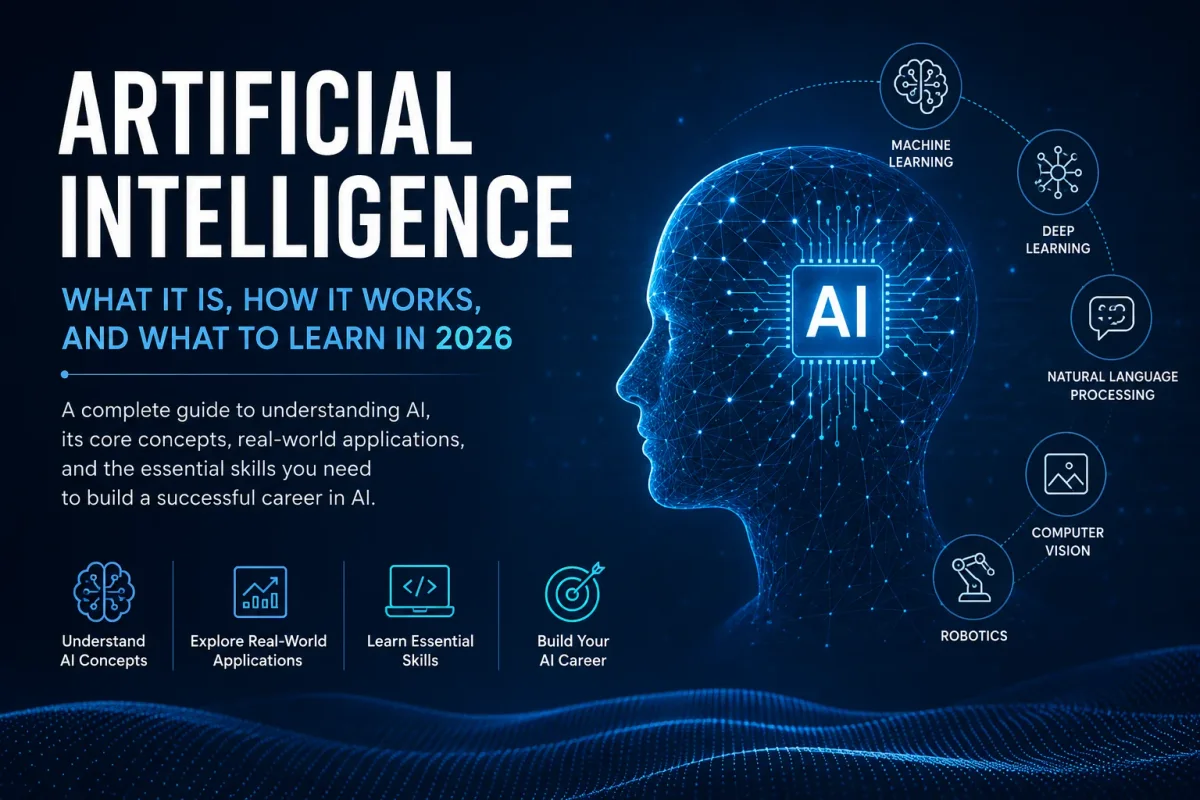
Artificial Intelligence (AI) is no longer a subject limited to research laboratories and university courses. It is already part of search engines, recommendation systems, software development tools, medical systems, financial services, robotics, and everyday consumer products.
But the rapid growth of AI has created a problem of its own: there is more information about AI than ever, and much of it is either too superficial or too specialized.
For someone trying to build a career in technology, learning AI is not about memorizing a list of tools or chasing every new model release. It is about understanding how intelligent systems work, learning the mathematics and programming behind them, building useful systems, and developing the engineering skills required to put those systems into production.
This guide explains what artificial intelligence actually means, how modern AI systems work, how AI relates to machine learning and deep learning, and what you should learn if you want to build a serious foundation in AI in 2026.
What Is Artificial Intelligence?
At its broadest, artificial intelligence is the field of building machines and software that can perform tasks that require some form of intelligence.
NIST describes an AI system as a machine-based system that, for human-defined objectives, can make predictions, recommendations, or decisions that influence real or virtual environments.
The OECD uses a closely related definition. Its current framework describes AI systems as machine-based systems that infer from inputs how to generate outputs such as predictions, content, recommendations, or decisions, with different systems varying in their autonomy and ability to adapt after deployment.
In practical terms, that means an AI system takes information as input, processes it using some form of model or decision-making mechanism, and produces an output.
For example:
- A recommendation system predicts which video you may want to watch next.
- A fraud detection model estimates whether a transaction is suspicious.
- A computer vision system identifies objects in an image.
- A language model generates or transforms text.
- A robotics system combines perception, planning, and control to act in the physical world.
The important idea is not that an AI system “thinks like a human.” Modern AI systems can be extremely capable while working in very different ways from human intelligence.
AI Is a Field, Not a Single Technology
One of the most common mistakes beginners make is treating AI as if it were a single technology.
It is not.
Artificial intelligence is a broad field containing several approaches, techniques, and subfields.
A simplified view looks like this:
Artificial Intelligence
│
├── Machine Learning
│   ├── Supervised Learning
│   ├── Unsupervised Learning
│   └── Reinforcement Learning
│
├── Deep Learning
│   ├── Neural Networks
│   ├── CNNs
│   ├── RNNs
│   └── Transformers
│
├── Generative AI
│   ├── Language Models
│   ├── Image Generation
│   ├── Audio Generation
│   └── Video Generation
│
├── Computer Vision
│
├── Natural Language Processing
│
├── Robotics
│
└── AI Engineering
These areas overlap heavily.
A modern AI product might combine machine learning, deep learning, natural language processing, retrieval systems, software engineering, databases, APIs, cloud infrastructure, and evaluation.
That is why learning AI properly requires more than learning a single framework.
How Does Artificial Intelligence Work?
There is no single algorithm called “AI.”
Different systems work in different ways.
Traditional AI systems can rely heavily on explicitly programmed rules. For example:
IF temperature > threshold
AND smoke_detected = true
THEN trigger_alarm
This approach can work well when the rules are known and predictable.
But many real-world problems are too complex to describe manually.
Imagine trying to write rules that describe every possible photograph of a cat.
You would quickly run into an impossible number of variations:
- different breeds
- different lighting
- different camera angles
- different backgrounds
- partially hidden objects
- different poses
- low-quality images
Machine learning approaches the problem differently.
Instead of manually writing every rule, we give a model data and allow it to learn patterns from that data.
A simplified machine learning pipeline looks like this:
Data
  ↓
Preprocessing
  ↓
Training
  ↓
Model
  ↓
Evaluation
  ↓
Deployment
  ↓
Predictions
The quality of the final system depends on much more than the model itself.
Data quality, problem formulation, evaluation, infrastructure, and deployment all matter.
This distinction becomes increasingly important as AI moves from research experiments into real products.
The Difference Between AI, Machine Learning, and Deep Learning
These terms are often used interchangeably, but they are not the same thing.
Artificial Intelligence
AI is the broadest concept.
It includes techniques used to create systems capable of producing intelligent behavior.
Machine Learning
Machine learning is a major approach within AI.
Instead of explicitly programming every rule, machine learning algorithms learn patterns from examples.
For example, instead of manually defining what makes an email spam, you can train a classification model on examples of spam and legitimate emails.
Deep Learning
Deep learning is a subfield of machine learning based primarily on neural networks with many layers.
Deep learning has been especially influential in areas such as:
- image recognition
- speech recognition
- natural language processing
- generative AI
- robotics
The relationship can therefore be simplified as:
Artificial Intelligence
        ↓
Machine Learning
        ↓
Deep Learning
Not every AI system uses machine learning, and not every machine learning system requires deep learning.
Understanding that distinction will save you from a great deal of confusion when you begin studying the field.
What Changed With Modern Generative AI?
Generative AI significantly changed how people interact with AI systems.
Traditional machine learning often focuses on predicting or classifying something:
Input → Model → PredictionGenerative systems can instead produce new content:
Prompt/Input → Model → Generated OutputDepending on the system, that output may be:
- text
- code
- images
- audio
- video
- structured data
Large language models are one of the most visible examples.
Modern AI development increasingly involves not just training models, but building systems around existing models.
That means engineers may work with:
- APIs
- model serving
- retrieval systems
- vector databases
- evaluation pipelines
- agents
- observability
- security
- inference optimization
- cloud infrastructure
This is one reason the distinction between “AI research” and “AI engineering” matters.
AI in 2026: Where the Field Stands
AI capability is advancing quickly rather than simply reaching a stable plateau.
Stanford’s 2026 AI Index reports that industry produced more than 90% of notable frontier models in 2025, while several frontier systems reached or exceeded human baselines on demanding benchmarks involving scientific reasoning, multimodal tasks, and mathematics.
The same report shows that AI adoption has expanded rapidly. Organizational AI adoption reached 88% in the 2025 data, while generative AI reached 53% population adoption within three years in the report’s tracked measure.
But greater capability does not mean AI systems are automatically reliable.
The 2026 AI Index also highlights weaknesses in areas such as hallucination, responsible AI evaluation, transparency, and governance.
This matters for anyone entering the field.
A strong AI engineer should not only know how to make a model produce impressive output. They should understand how to evaluate whether that output is correct, reliable, safe, and useful.
Why AI Engineering Is Becoming More Important
A useful AI model is only one part of a production system.
Consider an AI-powered document assistant.
You might need:
User Interface
      ↓
API
      ↓
Authentication
      ↓
Document Processing
      ↓
Retrieval
      ↓
Model
      ↓
Response Validation
      ↓
Database / Logging
The model is important, but the surrounding software determines whether the application is reliable.
This is where AI engineering sits.
AI engineering combines knowledge of AI and machine learning with software engineering and systems thinking.
A production AI engineer may need to understand:
- Python
- data structures and algorithms
- machine learning
- deep learning
- APIs
- databases
- Linux
- Git
- Docker
- cloud platforms
- testing
- monitoring
- model evaluation
That does not mean you need to master everything simultaneously.
It means your long-term learning should move beyond simply calling an AI API.
What Should You Learn to Get Started With AI?
If you’re starting from scratch, the wrong approach is to jump directly into advanced topics because they are currently popular.
A better approach is cumulative.
1. Programming
Start with programming fundamentals.
Python is particularly useful because it is widely used across AI and machine learning.
You should become comfortable with:
- variables and data types
- conditionals
- loops
- functions
- modules
- file handling
- exceptions
- object-oriented programming
- debugging
- virtual environments
- packages
You should also understand basic software engineering practices rather than treating Python as only a notebook language.
2. Mathematics
You do not need every branch of mathematics to begin working with AI.
The most useful foundation includes:
- linear algebra
- probability
- statistics
- calculus
- optimization
Linear algebra becomes important when working with vectors, matrices, embeddings, and neural networks.
Probability and statistics help you reason about uncertainty, distributions, estimation, and model evaluation.
Calculus becomes important for understanding optimization and gradient-based learning.
The objective is not to collect mathematical formulas.
The objective is to understand what the mathematics is doing inside the algorithms.
3. Data
Machine learning systems depend on data.
Learn how to:
- load data
- clean data
- explore data
- visualize distributions
- handle missing values
- encode categorical variables
- normalize or standardize features
- split datasets
- detect data leakage
Tools such as NumPy, pandas, and visualization libraries are useful here.
4. Machine Learning
Once your programming and mathematical foundation is strong enough, study machine learning systematically.
Start with concepts such as:
- linear regression
- logistic regression
- decision trees
- ensemble methods
- clustering
- dimensionality reduction
- model evaluation
- feature engineering
- regularization
- overfitting and underfitting
Do not judge your progress by how many algorithms you can name.
You should be able to explain why a method works, when it fails, and how you would evaluate it.
5. Deep Learning
After machine learning fundamentals, move into neural networks and deep learning.
Learn:
- perceptrons
- multilayer neural networks
- forward propagation
- backpropagation
- activation functions
- loss functions
- optimizers
- regularization
- convolutional networks
- sequence models
- transformers
At this stage, learning a framework such as PyTorch becomes useful.
6. Modern AI Systems
After the fundamentals, move into modern AI engineering.
Topics worth learning include:
- large language models
- embeddings
- vector search
- retrieval-augmented generation
- tool use
- agents
- model evaluation
- fine-tuning
- inference
- model serving
The important distinction is that these topics should build on your fundamentals rather than replace them.
What Should You Build While Learning AI?
Projects are where your knowledge becomes useful.
A good progression might look like:
Beginner
│
├── House Price Prediction
├── Spam Classifier
└── Image Classifier

Intermediate
│
├── Recommendation System
├── Document Search Engine
└── Machine Learning API

Advanced
│
├── RAG Application
├── AI Agent
├── Multimodal Application
└── Production AI System
A project should demonstrate more than the fact that you can follow a tutorial.
A strong project should answer:
- What problem are you solving?
- Why does the problem matter?
- What data or models are you using?
- How does the system work?
- How did you evaluate it?
- What limitations does it have?
- What would you improve next?
That is much closer to real engineering work.
What Should You Avoid Learning?
The AI ecosystem moves too quickly to learn everything.
You will constantly encounter:
- new models
- new frameworks
- new agents
- new benchmarks
- new libraries
- new APIs
- new AI startups
Most of them are not worth becoming an expert in.
Avoid building your entire learning strategy around whichever tool is trending this month.
For example, spending months learning how to use one particular AI API without understanding machine learning, software engineering, data, or evaluation will leave you with shallow knowledge.
Learn principles first and tools second.
Tools change.
Fundamentals last much longer.
What Is the Best Way to Learn AI?
The most effective approach is not purely theoretical and not purely project-based.
You need both.
A strong cycle is:
Learn a concept
     ↓
Implement it
     ↓
Solve problems
     ↓
Build a project
     ↓
Measure the result
     ↓
Read what you got wrong
     ↓
Improve the system
For example, don’t stop after learning linear regression.
Implement it from scratch.
Then use scikit-learn.
Then compare your implementation with the library.
Then build a real prediction project.
Then analyze where the model fails.
That process builds understanding much faster than collecting certificates.
Do You Need to Learn AI From the Latest Tools?
No.
In fact, starting with the newest tools can make learning harder.
A better sequence is:
Programming
    ↓
Mathematics
    ↓
Data
    ↓
Machine Learning
    ↓
Deep Learning
    ↓
Generative AI
    ↓
AI Engineering
    ↓
Production Systems
Once you have that foundation, new technologies become much easier to understand.
A new model architecture is then something you can evaluate.
A new framework is something you can learn quickly.
A new AI product is something you can understand rather than simply use.
That difference compounds over time.
The Future of AI Is Not Only About Models
The AI industry is often discussed in terms of which company has the strongest model.
That matters.
But the larger engineering opportunity is broader.
AI systems increasingly need:
- better evaluation
- efficient inference
- reliable infrastructure
- high-quality data
- security
- monitoring
- human oversight
- domain-specific applications
- responsible deployment
NIST’s 2026 work on trustworthy and responsible AI emphasizes the need for evaluation, testing, validation, and verification after deployment because real-world AI behavior can differ from controlled pre-deployment testing.
That is a useful lesson for anyone learning AI: building the model is not the finish line.
Frequently Asked Questions
Is AI difficult to learn?
AI has a steep learning curve because it combines programming, mathematics, statistics, machine learning, and engineering.
But you do not need to learn everything at once.
The difficulty comes mainly from the number of connected concepts, not from any single topic.
Should I learn Python before AI?
Yes.
Python is one of the most useful languages for AI and machine learning, and learning programming fundamentals first will make later topics significantly easier.
Do I need advanced mathematics for AI?
You need mathematical understanding, but not all of mathematics.
Start with linear algebra, probability, statistics, calculus, and optimization as your AI work becomes more advanced.
Should I learn machine learning before generative AI?
For a strong technical foundation, yes.
You can build useful applications with generative AI without studying traditional machine learning first, but understanding machine learning and deep learning will give you a much better understanding of how modern AI systems work.
Is AI engineering the same as machine learning engineering?
They overlap, but the responsibilities can differ.
Machine learning engineering traditionally focuses heavily on developing, training, evaluating, and deploying machine learning models.
AI engineering is increasingly used for the broader task of building applications and systems around modern AI models, including retrieval, agents, APIs, evaluation, infrastructure, and product integration.
The exact role definition varies between companies.
Will AI replace software engineers?
That question is too broad to have a useful yes-or-no answer.
AI is already changing software development, and the effect is unlikely to be uniform across roles and experience levels. The more useful strategy is to become good at engineering problems that remain difficult: understanding requirements, designing systems, evaluating trade-offs, debugging, verifying correctness, and building reliable products.
Final Thoughts
Artificial intelligence is a large and fast-moving field, but learning it does not require chasing everything happening in AI.
Start with fundamentals.
Learn to program.
Learn the mathematics.
Understand data.
Study machine learning.
Move into deep learning.
Then learn modern generative AI and AI engineering.
Most importantly, build things.
The people who develop durable AI skills will not simply know how to use the latest model. They will understand the underlying ideas well enough to learn new tools quickly, evaluate systems critically, and turn AI capabilities into useful products.
That is the real opportunity in AI in 2026.
Where to Go Next
If you’re building your AI foundation, the natural next step is to study Machine Learning in more depth.
Continue with:
Artificial Intelligence → Machine Learning → Deep Learning → LLMs → AI Engineering
And alongside that:
Learn → Build → Deploy → Evaluate → Improve
That combination will take you much further than simply learning how to prompt an AI tool.
Sources
- NIST, Artificial Intelligence Glossary — definition of AI systems.
- OECD, The Future of Artificial Intelligence: OECD Digital Economy Outlook 2024 — AI system terminology.
- Stanford HAI, 2026 AI Index Report — current trends in AI capability, adoption, research, and responsible AI.
- NIST, Trustworthy and Responsible AI (2026) — evaluation and post-deployment considerations.
Continue the path
Keep building from here
Deep Learning: How Neural Networks Work and How to Learn It
Learn deep learning from neural networks and backpropagation to PyTorch, CNNs, transformers, projects, and practical study strategy.
Machine Learning: How It Works and How to Learn It
Learn machine learning from fundamentals to projects: models, evaluation, overfitting, algorithms, Python, and a practical learning path.
AI Engineer Roadmap
A practical AI engineer roadmap covering software engineering, math, ML, deep learning, LLMs, deployment, evaluation, and career preparation.
AI Research Assistant
Build an LLM research assistant with document search, evidence retrieval, grounded summaries, source comparison, and citations.
Hands-On Machine Learning
A practical reference for machine learning with Python, scikit-learn, deep learning, and modern ML workflows.
Practical Deep Learning for Coders
A practical course centered on building and training deep learning systems with a strong implementation focus.