
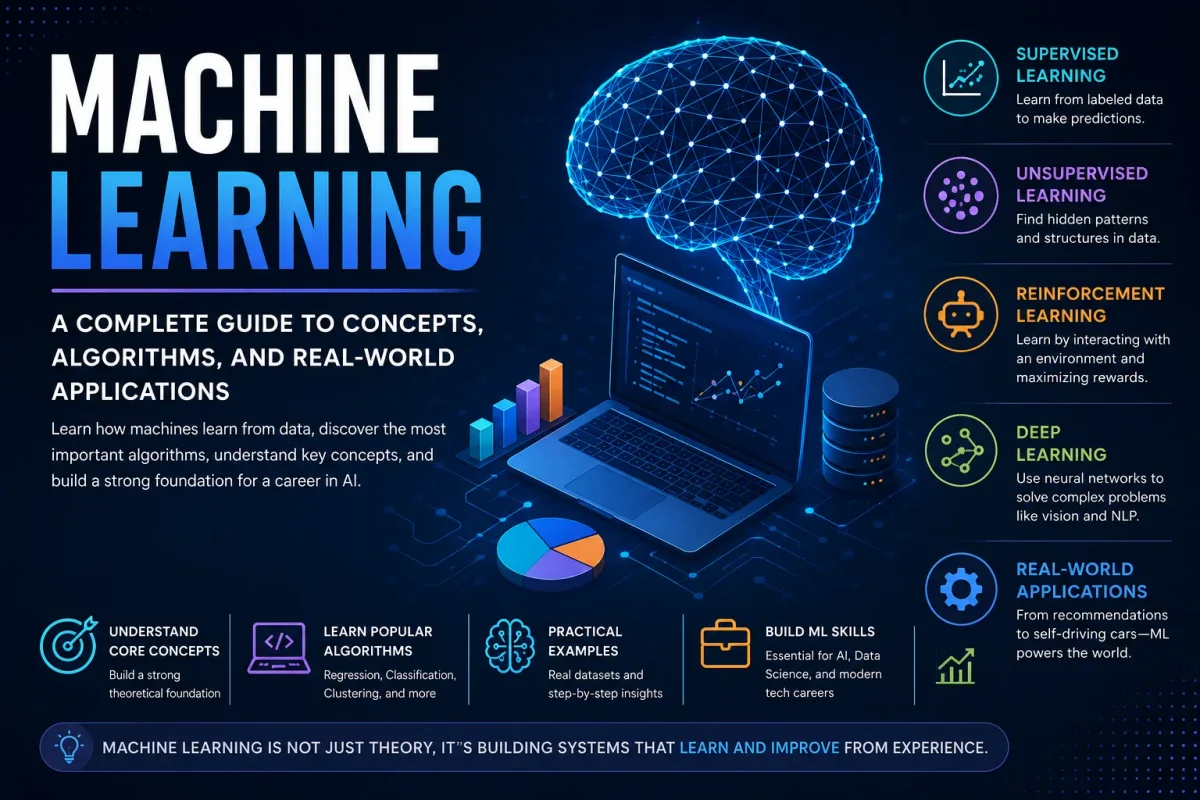
Machine learning (ML) is the part of artificial intelligence that lets computer systems improve their performance by learning patterns from data rather than relying entirely on hand-written rules.
That sounds simple, but learning machine learning well is not simply a matter of learning algorithms such as linear regression, decision trees, or neural networks. The real skill is understanding the complete process: defining a problem, collecting and preparing data, choosing an appropriate model, training it, evaluating it on unseen examples, diagnosing mistakes, and deploying it responsibly.
NIST defines machine learning as the development and use of computer systems that adapt and learn from data with the goal of improving accuracy. (NIST Machine Learning Glossary)
For someone entering AI, machine learning is one of the most important foundations to build. It gives you the vocabulary and intuition needed to understand modern AI systems, including deep learning and many of the systems behind today’s generative AI products.
This guide explains machine learning from the ground up, how the major types of ML differ, how training actually works, what makes a model useful, what beginners commonly get wrong, and how to build a practical learning path in 2026.
What Is Machine Learning?
Traditional software usually follows an explicitly designed set of rules:
Input
  ↓
Hand-written rules
  ↓
Output
Machine learning changes the approach.
Instead of writing every rule manually, you give a learning algorithm examples and let it infer a pattern that can be used to make predictions on new data.
The simplified picture is:
Training data
      ↓
Learning algorithm
      ↓
Trained model
      ↓
New input
      ↓
Prediction
Suppose you want to predict the price of a house.
A conventional program could use rules written by a developer:
if bedrooms > 3:
    increase_price()
That approach becomes difficult as the problem grows.
A machine learning system can instead learn relationships between features such as:
- area
- location
- number of bedrooms
- age of the property
- distance from services
- historical sale price
The model learns from examples where the correct outcome is already known, then uses those learned relationships to estimate the price of a new property.
The important distinction is this:
Machine learning does not eliminate the need for human reasoning. It moves much of the rule-discovery process from manually written code into data, algorithms, and optimization.
Why Machine Learning Matters
Machine learning is useful when a problem contains patterns that are difficult to specify with fixed rules but can be learned from examples.
It powers systems such as:
- spam filtering
- search ranking
- fraud detection
- recommendation systems
- demand forecasting
- speech recognition
- image classification
- credit-risk estimation
- anomaly detection
- predictive maintenance
The techniques vary, but the core idea is similar: use data to learn a function that maps inputs to useful outputs.
That is why data quality, model evaluation, and generalization are central to machine learning.
A model that performs brilliantly on the data it has already seen but fails on new data is not a successful machine learning system.
The Basic Machine Learning Workflow
A practical ML project is much broader than choosing an algorithm.
A useful high-level workflow is:
Problem Definition
        ↓
Data Collection
        ↓
Data Cleaning
        ↓
Exploratory Analysis
        ↓
Feature Engineering
        ↓
Train / Validation / Test Split
        ↓
Model Training
        ↓
Evaluation
        ↓
Error Analysis
        ↓
Deployment
        ↓
Monitoring
Each stage can make or break the final result.
For example, a technically sophisticated model cannot rescue a dataset with incorrect labels, severe leakage, or a mismatch with the real-world problem.
Google’s Machine Learning Crash Course emphasizes the importance of dataset quality and data preparation, noting that a large share of ML project effort often goes into constructing, cleaning, and transforming data. (Google for Developers)
Types of Machine Learning
The three broad categories most beginners encounter are supervised learning, unsupervised learning, and reinforcement learning.
Supervised Learning
In supervised learning, the training examples include a target or label.
The model learns a relationship between input features and known outputs.
Features + Target
       ↓
     Model
       ↓
Prediction
Two major supervised learning tasks are regression and classification.
Regression
Regression predicts a continuous value.
Examples:
- house price
- temperature
- demand
- delivery time
- revenue
A simple linear regression problem may look like:
Hours studied → Exam scoreThe output is a numerical value.
Classification
Classification predicts a category.
Examples:
- spam vs. not spam
- fraud vs. legitimate
- cat vs. dog
- positive vs. negative sentiment
Classification can be binary or involve multiple classes.
Scikit-learn’s current user guide organizes a wide range of supervised learning methods, including linear models, support vector machines, nearest neighbors, decision trees, ensembles, naive Bayes, and neural network models. (scikit-learn User Guide)
Unsupervised Learning
In unsupervised learning, the dataset does not provide a target label for the model to predict.
Instead, the goal is often to discover useful structure in the data.
Common examples include:
- clustering customers
- finding groups of similar documents
- detecting unusual patterns
- reducing the dimensionality of data
A common clustering method is K-means.
You give it observations and ask the algorithm to divide them into groups according to similarity.
The important point is that the system is not told in advance what each group should mean.
Reinforcement Learning
Reinforcement learning is based on an agent interacting with an environment.
The agent takes actions, receives feedback in the form of rewards or penalties, and learns a strategy that aims to improve future outcomes.
The simplified idea is:
State
  ↓
Action
  ↓
Environment
  ↓
Reward
  ↓
Updated strategy
Reinforcement learning is particularly relevant to sequential decision-making problems, including some robotics, games, control systems, and other environments where actions influence future states.
For many beginners, supervised learning is the best place to start because it introduces the core ideas of datasets, features, targets, training, prediction, and evaluation.
Features, Targets, and Samples
Machine learning becomes much easier to understand once you are comfortable with three basic terms.
Sample
A sample is one example in your dataset.
For a house-price dataset, one row may represent one house.
Feature
A feature is an input variable used to make a prediction.
Examples:
- area
- bedrooms
- age
- location score
Target
The target is the value the model is trying to predict in a supervised learning problem.
For house-price prediction:
Features:
area
bedrooms
age
location

Target:
price
This vocabulary appears everywhere in machine learning.
How Does a Machine Learning Model Learn?
At the center of many ML algorithms is an objective: make useful predictions while minimizing some measure of error.
Suppose a model predicts house prices.
For each training example:
Actual price
     vs.
Predicted price
The difference contributes to a loss function.
A simplified training loop looks like:
Initialize model parameters
          ↓
Make predictions
          ↓
Calculate loss
          ↓
Adjust parameters
          ↓
Repeat
The exact optimization procedure depends on the algorithm.
For linear models, neural networks, tree-based models, and other methods, the mechanics differ. But the general idea is similar:
use data to adjust a model so that its predictions become better according to a chosen objective.
This is one of the most important ideas to understand before moving into deep learning.
Training, Validation, and Test Data
One of the most important habits in machine learning is separating the data used to learn from the data used to judge performance.
A common setup is:
Dataset
  │
  ├── Training set
  │
  ├── Validation set
  │
  └── Test set
Training Set
Used to fit the model.
Validation Set
Used during development to compare approaches, tune hyperparameters, and make decisions without repeatedly touching the final test set.
Test Set
Used for final evaluation on data the model has not been trained on.
Google recommends keeping a separate test dataset for evaluating how well a model performs on unseen data and explains why repeatedly using evaluation data during development can undermine the reliability of the final measurement. (Google for Developers)
This separation is not bureaucracy. It is an attempt to answer a simple question:
Does the model work on new data, or did it simply become very good at the examples we showed it?
Generalization: The Real Goal
A model is useful when it generalizes.
Generalization means the model learned patterns that continue to work on new examples rather than merely memorizing the training data.
Imagine a student who memorizes the answers to 100 practice questions but cannot solve a new question in the same topic.
That student has memorized examples without developing a transferable understanding.
A badly overfit model has a similar problem.
Google describes overfitting as a situation in which a model performs well on training data but performs poorly on new, unseen data. (Google for Developers)
Underfitting and Overfitting
Two concepts appear constantly in machine learning.
Underfitting
An underfit model is too simple to capture the useful patterns in the data.
It may perform poorly on both training and new data.
Overfitting
An overfit model learns the training data too closely and fails to generalize.
It may show:
Training performance → excellent
Validation performance → poor
Common causes include:
- overly complex models
- too little training data
- noisy data
- poor feature choices
- insufficient regularization
- data leakage or flawed evaluation
The goal is not to build the most complicated model.
The goal is to build a model that captures useful signal and generalizes reliably.
Common Machine Learning Algorithms
You do not need to memorize every algorithm available.
A smaller collection of models will teach you most of the core ideas you need at the beginning.
Linear Regression
Used for predicting continuous values.
It is one of the best algorithms for learning about:
- features
- parameters
- loss functions
- optimization
- residuals
- model assumptions
Logistic Regression
Despite its name, logistic regression is commonly used for classification.
It is a useful introduction to:
- probabilities
- decision boundaries
- classification metrics
- regularization
Decision Trees
Decision trees make predictions through a sequence of conditional splits.
They are intuitive and useful for understanding how models create decision boundaries from features.
Random Forests
Random forests combine many decision trees and are powerful baseline models for many tabular datasets.
Gradient Boosting
Boosting methods build models sequentially, with later models focusing on errors made by earlier ones.
Modern gradient-boosting implementations are widely used for structured and tabular data.
K-Nearest Neighbors
KNN makes predictions based on nearby training examples.
It is conceptually simple and useful for developing intuition about distance and feature scaling.
Support Vector Machines
SVMs seek decision boundaries that separate classes effectively and can be extended using kernel methods.
Clustering Algorithms
K-means is a common starting point for unsupervised learning.
Other techniques include hierarchical clustering and density-based methods.
Scikit-learn provides implementations and utilities across supervised and unsupervised learning, preprocessing, model selection, and evaluation. (scikit-learn)
Why Data Often Matters More Than the Algorithm
Beginners often ask:
Which is the best machine learning algorithm?
That question is usually incomplete.
The answer depends on:
- the problem
- the dataset
- the features
- the evaluation metric
- computational constraints
- interpretability requirements
- the environment where the model will run
A brilliant algorithm trained on poor data can still produce poor results.
Google’s ML material makes the point directly: dataset quality and construction can matter more than choosing a more sophisticated algorithm. (Google for Developers)
This is one of the biggest mindset shifts in machine learning.
Data is not a side task. Data is part of the model.
Data Leakage: One of the Most Dangerous Beginner Mistakes
Data leakage occurs when information that should not be available to the model during prediction accidentally enters the training process.
Imagine trying to predict whether a customer will cancel a subscription.
If you include a feature that is only recorded after cancellation, your model may appear extremely accurate.
But the feature would not actually be available when the prediction needs to be made.
The result is an impressive-looking model that cannot work in the real system.
Leakage can happen through:
- preprocessing before dataset splitting
- future information
- duplicated examples
- target-derived features
- incorrect validation procedures
A good ML practitioner always asks:
Would this information genuinely be available at prediction time?
Evaluation Metrics
Accuracy is useful in some situations, but it is not enough to evaluate every model.
The metric should match the problem.
Regression Metrics
Common choices include:
- Mean Absolute Error (MAE)
- Mean Squared Error (MSE)
- Root Mean Squared Error (RMSE)
- R²
Classification Metrics
Common choices include:
- accuracy
- precision
- recall
- F1 score
- ROC-AUC
- log loss
Consider fraud detection.
If only 1 out of 1,000 transactions is fraudulent, a model that predicts “not fraud” every time could achieve extremely high accuracy while being completely useless.
This is why understanding the business or real-world objective is essential.
Baselines Matter
Before building a sophisticated model, create a simple baseline.
For example:
Baseline
   ↓
Linear model
   ↓
Tree model
   ↓
Ensemble
   ↓
More advanced approach
A baseline tells you whether the added complexity is actually buying you something.
If a complicated model barely beats a simple baseline, you should investigate why before adding more complexity.
Good machine learning is not about complexity for its own sake.
Machine Learning Libraries You Should Know
You can implement many algorithms from scratch, and doing so is extremely valuable for learning.
But real projects often use established libraries.
For Python-based machine learning, important tools include:
NumPy
Useful for numerical computing and arrays.
pandas
Useful for data manipulation and tabular analysis.
Matplotlib and Seaborn
Useful for visualization and exploratory data analysis.
scikit-learn
A central library for classical machine learning.
It provides tools for:
- preprocessing
- model fitting
- prediction
- model selection
- cross-validation
- evaluation
- supervised learning
- unsupervised learning
Scikit-learn describes itself as an open-source machine learning library supporting supervised and unsupervised learning along with preprocessing, model selection, model evaluation, and related utilities. (scikit-learn)
Later, when you move into deep learning, frameworks such as PyTorch become increasingly important.
How Machine Learning Connects to Deep Learning
Deep learning is a subfield of machine learning that relies heavily on neural networks.
The progression is roughly:
Artificial Intelligence
        ↓
Machine Learning
        ↓
Deep Learning
        ↓
Modern Generative AI
Classical machine learning remains extremely useful, particularly for many structured-data problems.
Deep learning becomes especially important when working with complex unstructured data and large-scale representation learning, including:
- images
- audio
- natural language
- multimodal data
Learning classical ML first gives you an important conceptual foundation:
- what a dataset is
- how models are trained
- how optimization works
- how evaluation works
- what overfitting means
- why data quality matters
Those ideas remain relevant when the models become much larger.
What Should You Learn Before Machine Learning?
You don’t need a PhD-level mathematical background to begin.
You do need a working foundation.
Programming
You should be comfortable with Python fundamentals:
- functions
- loops
- data structures
- modules
- exceptions
- file handling
- object-oriented programming
- debugging
Mathematics
Focus on:
- linear algebra
- probability
- statistics
- basic calculus
- optimization concepts
You don’t need to complete all of advanced mathematics before touching ML.
Learn mathematics alongside the algorithms that make it useful.
Data Analysis
Know how to work with:
- NumPy
- pandas
- data visualization
- missing values
- categorical variables
- distributions
- correlations
- train/test splits
The goal is to be able to inspect a dataset before throwing a model at it.
A Practical Machine Learning Learning Path
A sensible progression is:
1. Python
   ↓
2. NumPy + pandas + visualization
   ↓
3. Mathematics for ML
   ↓
4. Data preprocessing
   ↓
5. Linear regression
   ↓
6. Logistic regression
   ↓
7. Classification
   ↓
8. Decision trees
   ↓
9. Random forests
   ↓
10. Gradient boosting
   ↓
11. Unsupervised learning
   ↓
12. Model evaluation
   ↓
13. Feature engineering
   ↓
14. Regularization
   ↓
15. Cross-validation
   ↓
16. End-to-end ML projects
   ↓
17. Deep learning
The order can change somewhat depending on your background, but the important thing is progression.
Don’t jump from basic Python directly into RAG frameworks just because they are popular.
Build the foundation first.
How to Study Machine Learning Properly
Reading about algorithms is not enough.
Use a repeatable cycle:
Understand
   ↓
Implement
   ↓
Experiment
   ↓
Evaluate
   ↓
Build
   ↓
Explain
Suppose you’re learning linear regression.
Don’t stop after understanding the equation.
Try this:
- Understand the intuition.
- Implement it with basic Python and NumPy.
- Visualize the predictions.
- Implement a version using scikit-learn.
- Compare the results.
- Study the errors.
- Change the data.
- Explain why the model behaves differently.
The same approach works for classification, trees, clustering, and later neural networks.
Machine Learning Projects to Build
Projects are the fastest way to move from theoretical familiarity to actual competence.
Beginner Projects
Start with small, understandable problems.
Examples:
- house-price prediction
- student-score prediction
- spam classification
- customer churn prediction
- simple sentiment classification
Intermediate Projects
Once you understand the fundamentals, build systems involving more realistic data and stronger evaluation.
Examples:
- recommendation system
- credit-risk classifier
- fraud detection model
- customer segmentation
- demand forecasting
- document classification
Advanced Projects
At this stage, the goal is no longer just training a model.
Build an end-to-end system.
Examples:
- machine learning API
- real-time anomaly detection system
- production recommendation service
- document search platform
- RAG application
- model monitoring system
A strong project should include:
Problem
  ↓
Data
  ↓
Exploration
  ↓
Preprocessing
  ↓
Model
  ↓
Evaluation
  ↓
API / Application
  ↓
Deployment
  ↓
Monitoring
That demonstrates engineering ability, not just notebook proficiency.
Common Machine Learning Mistakes
Learning algorithms without understanding the data
A model is only as good as the problem formulation and data pipeline behind it.
Chasing the most advanced model
A simple model with clean data can outperform a complicated model with poor inputs.
Using the test set during development
This quietly turns your test set into another development dataset.
Optimizing for the wrong metric
The highest accuracy may not represent the business objective.
Ignoring class imbalance
Rare-event problems often require more careful metrics and sampling strategies.
Skipping a baseline
Without a baseline, you don’t know whether your complexity is justified.
Building only notebook projects
A notebook demonstrates experimentation.
A deployed system demonstrates engineering.
You eventually need both.
Machine Learning in 2026
Machine learning remains foundational even as the AI industry focuses heavily on generative models and foundation models.
The 2026 Stanford AI Index describes rapid progress across language, vision, speech, robotics, and agentic systems, with industry producing more than 90% of notable frontier models in 2025. (Stanford HAI AI Index 2026)
This does not make classical machine learning obsolete.
Quite the opposite.
The underlying skills remain valuable:
- data preparation
- feature representation
- optimization
- statistical reasoning
- evaluation
- experimentation
- generalization
- production monitoring
What is changing is the scale and variety of models being built around those principles.
For an aspiring AI engineer, machine learning should therefore be treated as a foundation rather than a trend.
Is Machine Learning Still Worth Learning?
Yes.
But learn it for the right reason.
Do not study machine learning simply so you can put “ML” on your resume.
Study it so you can answer questions such as:
- What should this model predict?
- What data should it use?
- How should the data be represented?
- What counts as success?
- How do we know the model generalizes?
- Why is it making mistakes?
- How should we deploy it?
- What happens when the real-world data changes?
Those are engineering questions.
The algorithms are tools for answering them.
Frequently Asked Questions
Is machine learning the same as artificial intelligence?
No.
Artificial intelligence is the broader field. Machine learning is one major approach within AI.
Is machine learning hard?
It can be difficult because it combines programming, mathematics, data analysis, and problem solving.
The best way to make it manageable is to learn the concepts progressively and build projects as you go.
Can I learn machine learning without calculus?
Yes, you can begin without advanced calculus.
But as you move deeper into optimization and neural networks, calculus becomes increasingly useful for understanding what is happening under the hood.
Should I learn Python before machine learning?
Yes.
Python is widely used for machine learning and gives you access to the major scientific and ML ecosystem.
Should I learn scikit-learn or implement algorithms from scratch?
Both.
Implementing important algorithms from scratch is excellent for learning. Scikit-learn is useful for building practical models and understanding real workflows.
How long does it take to learn machine learning?
There is no meaningful fixed number of days or weeks.
You can understand the basics relatively quickly, but becoming genuinely competent requires repeated practice, projects, experimentation, and experience with real datasets.
Should I learn deep learning immediately after Python?
Usually no.
A stronger path is Python → data → mathematics → classical ML → deep learning.
You can experiment with neural networks earlier, but don’t let them replace the foundations.
Final Thoughts
Machine learning is not primarily about knowing a hundred algorithms.
It is about learning how to turn data into systems that make useful predictions and decisions.
The strongest foundation comes from understanding the entire process:
Problem
  ↓
Data
  ↓
Representation
  ↓
Model
  ↓
Training
  ↓
Evaluation
  ↓
Generalization
  ↓
Deployment
  ↓
Monitoring
Once you understand that process, individual algorithms become easier to learn.
More importantly, you become much harder to confuse with hype.
You can evaluate whether a new technique is actually useful, identify when a model is overfitting, recognize poor evaluation, and decide when a simple solution is better than a complicated one.
That is the kind of machine learning knowledge that compounds.
Where to Go Next
If you have a solid understanding of classical machine learning, the natural next step is Deep Learning.
The progression for AI Career Guide is:
Artificial Intelligence → Machine Learning → Deep Learning → LLMs → AI Engineering
And while studying:
Learn → Implement → Build → Evaluate → Deploy
The goal is not to become someone who can train a model once.
The goal is to become someone who can build, understand, evaluate, and improve machine learning systems.
Sources
- NIST — Machine Learning Glossary
- scikit-learn — Getting Started
- scikit-learn — User Guide
- Google for Developers — Datasets, Generalization, and Overfitting
- Google for Developers — Dividing the Original Dataset
- Google for Developers — Overfitting
- Stanford HAI — 2026 AI Index Report
Continue the path
Keep building from here
Artificial Intelligence Explained: How AI Works
Understand AI, machine learning, deep learning, and generative AI, then follow a practical path to build a strong AI foundation.
AI Engineering: What It Is and How to Become an AI Engineer
Learn how AI engineers build production systems with models, APIs, data, RAG, evaluation, deployment, security, and observability.
AI Engineer Roadmap
A practical AI engineer roadmap covering software engineering, math, ML, deep learning, LLMs, deployment, evaluation, and career preparation.
House Price Prediction
Build an end-to-end house price regression project covering data cleaning, feature engineering, model evaluation, and deployment.
Hands-On Machine Learning
A practical reference for machine learning with Python, scikit-learn, deep learning, and modern ML workflows.
UCI Machine Learning Repository
A collection of datasets useful for learning and experimenting with machine learning workflows.