
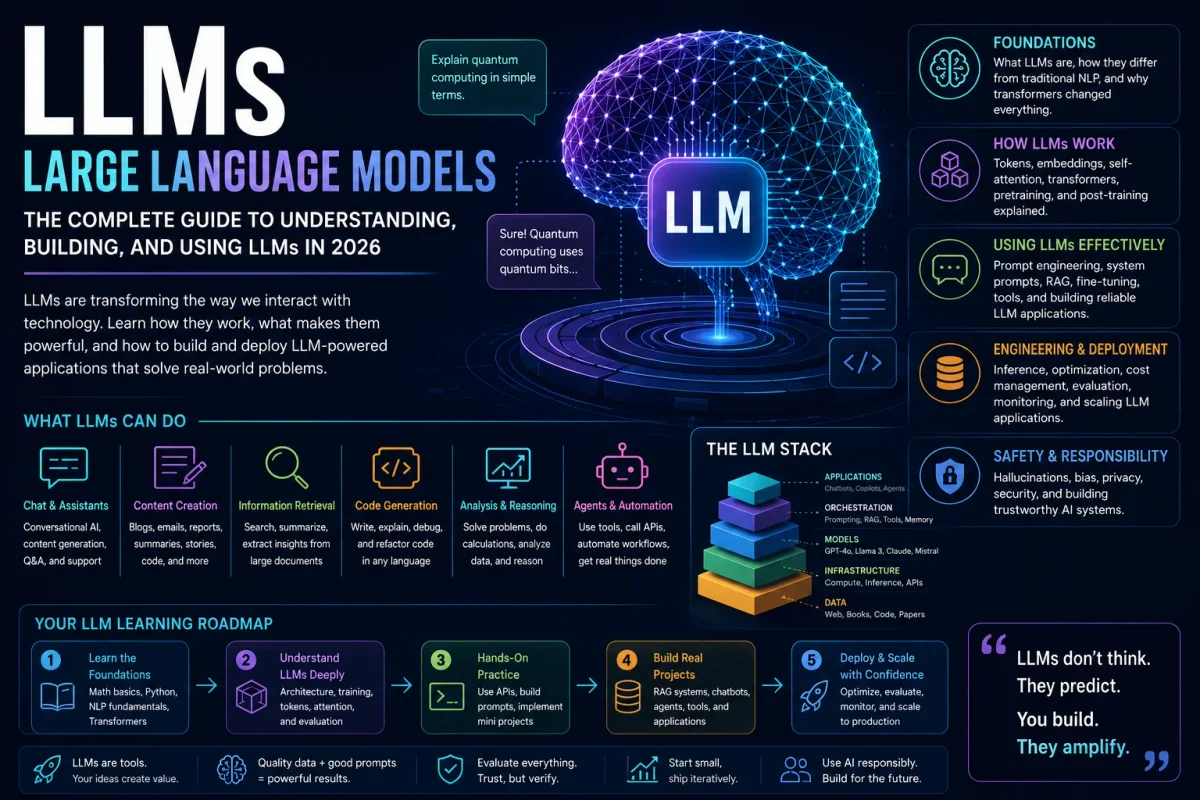
Large language models (LLMs) have changed the way people write software, search for information, analyze documents, learn new subjects, and build products.
But using an LLM is not the same as understanding one.
A strong AI engineer should know what a language model actually predicts, why tokens matter, how transformers use attention, what pretraining and post-training do, why models hallucinate, when retrieval is better than fine-tuning, and how to evaluate an LLM application in production.
Hugging Face’s current LLM course describes LLMs as a major class of language models and covers transformers, tokenization, inference, fine-tuning, datasets, evaluation, and reasoning models as part of a modern learning path. It also recommends having a good Python foundation and introductory deep learning knowledge before diving deeply into LLMs. (Hugging Face LLM Course)
This guide takes the same practical view.
The goal is not to turn you into someone who can merely call an AI API. The goal is to help you understand the technology well enough to build reliable systems around it.
What Is a Large Language Model?
A large language model is a machine learning model trained on large amounts of text and related data to model patterns in language.
At its simplest, a language model learns to predict what token is likely to come next given previous tokens.
For example:
The capital of France is ...A trained model might assign high probability to:
ParisBut the model is doing much more than memorizing a list of answers.
During training, it learns statistical relationships among tokens and develops internal representations that can support many different language tasks.
These capabilities can include:
- text generation
- summarization
- translation
- question answering
- classification
- information extraction
- code generation
- rewriting
- reasoning-like problem solving
- tool use
The exact capabilities depend on the model, training data, architecture, post-training process, and inference setup.
LLMs and NLP
Natural Language Processing, or NLP, is the broader field concerned with enabling computers to process human language.
LLMs are one important part of modern NLP.
A useful hierarchy is:
Artificial Intelligence
        ↓
Machine Learning
        ↓
Deep Learning
        ↓
Natural Language Processing
        ↓
Large Language Models
The hierarchy is not perfectly exclusive because NLP contains methods that are not deep learning, and modern models can work across multiple modalities.
Still, this gives you a useful mental map.
If you understand machine learning, deep learning, and NLP foundations, LLMs become much easier to study.
Why LLMs Became So Important
The key architectural development behind modern LLMs is the Transformer.
The original Transformer paper, Attention Is All You Need, introduced an architecture based entirely on attention mechanisms rather than recurrence or convolution. The paper showed that this design could achieve strong results while being more parallelizable during training. (Vaswani et al., 2017)
Transformers later became the foundation for many large language models.
Their importance comes from the ability to model relationships between tokens efficiently and to scale training across large datasets and compute systems.
That scalability changed the field.
How Does an LLM Work?
A simplified LLM pipeline looks like this:
Text
 ↓
Tokenization
 ↓
Token IDs
 ↓
Embeddings
 ↓
Transformer Layers
 ↓
Output Scores
 ↓
Next-Token Prediction
 ↓
Generated Text
A production system adds much more around the model:
User
 ↓
Application
 ↓
Prompt / Context Construction
 ↓
Retrieval or Tools
 ↓
LLM
 ↓
Validation / Post-processing
 ↓
Response
 ↓
Logging / Evaluation
The second diagram is much closer to how modern AI products are actually built.
Tokens: The Basic Unit of an LLM
LLMs generally do not process text as complete words.
They process tokens.
A token can correspond to:
- a complete word
- part of a word
- punctuation
- whitespace patterns
- other pieces of text
For example, a sentence might be split into units roughly like:
"Machine learning is useful."
       ↓
["Machine", " learning", " is", " useful", "."]
The exact tokenization depends on the tokenizer.
This matters because model input and output limits are usually measured in tokens rather than characters or words.
Tokenization is also important for:
- context-window usage
- inference cost
- latency
- prompt design
- dataset preparation
- fine-tuning
The current Hugging Face course includes dedicated material on tokenization and tokenizers because they are fundamental to working with transformer models and LLMs. (Hugging Face Course)
Embeddings: Turning Tokens Into Vectors
A neural network cannot directly operate on the word “machine” in its textual form.
Tokens are therefore converted into numerical representations called embeddings.
A simplified view is:
Token
 ↓
Token ID
 ↓
Embedding Vector
A token might be represented as a vector with hundreds or thousands of numerical dimensions.
These representations give the model a mathematical space in which relationships can be learned.
Embeddings are also useful outside the core model.
Modern AI applications often create embeddings for:
- documents
- sentences
- products
- code
- images
- queries
Those vectors can then be compared for semantic similarity.
This is a key building block for retrieval systems and semantic search.
The Transformer Architecture
A transformer is built from repeated blocks that process token representations.
A simplified decoder-style transformer looks like:
Input Tokens
     ↓
Token Embeddings
     ↓
Positional Information
     ↓
Transformer Block
     ├── Self-Attention
     ├── Feed-Forward Network
     └── Residual Connections / Normalization
     ↓
Repeated Blocks
     ↓
Output Layer
     ↓
Token Probabilities
The exact implementation varies across model families.
But these are the concepts you should understand first.
Self-Attention
Self-attention allows the model to consider relationships among tokens in the current context.
For example, in:
"Tushar put the laptop on the table because it was broken."understanding what “it” refers to requires considering relationships across the sequence.
Attention gives the network a mechanism for assigning different weights to different parts of the context.
The original Transformer architecture was built around attention rather than recurrence. (Attention Is All You Need)
Query, Key, and Value
Self-attention is commonly described using three learned representations:
- Query
- Key
- Value
A simplified expression is:
Attention(Q, K, V)
=
softmax(QKᵀ / √dₖ)V
You do not need to memorize the equation.
You should understand its purpose:
the model uses relationships between queries and keys to determine how information from values should be combined.
Multi-Head Attention
Transformers usually use multiple attention heads.
Each head can learn different relationships within the representation.
The outputs are then combined.
This gives the network multiple ways to process the same context.
Feed-Forward Networks
After attention, transformer blocks contain feed-forward networks that apply learned transformations independently to each position.
A transformer block therefore alternates between mixing contextual information and transforming the resulting representations.
Why Context Length Matters
An LLM does not have unlimited context.
It can process only a finite number of tokens within a given context window.
Longer context can be useful, but it is not automatically better.
More context can introduce:
- higher computation
- more memory usage
- higher latency
- irrelevant information
- increased prompt complexity
For an AI engineer, context management is therefore an engineering problem.
A good application does not simply stuff every available document into the prompt.
It retrieves and constructs the most useful context for the task.
Pretraining: How LLMs Learn Language Patterns
The first major stage of building a language model is pretraining.
At a high level:
Large Dataset
     ↓
Tokenization
     ↓
Training Examples
     ↓
Transformer Model
     ↓
Next-Token Prediction
     ↓
Gradient Updates
     ↓
Repeated Over Huge Amounts of Data
For a causal language model, the training objective can be simplified as predicting the next token.
For example:
Input:
"The sky is"

Target:
"blue"
Over huge numbers of examples, the model learns parameters that improve its predictions.
The model is not manually taught grammar rules one by one.
Language structure emerges through training.
Pretraining Is Not the Whole Story
A pretrained model is not necessarily a good conversational assistant.
The pretrained model may simply be very good at continuing text.
Modern systems generally involve additional training or prompting procedures that shape behavior for useful interactions.
This can include:
- supervised fine-tuning
- preference optimization
- instruction tuning
- reinforcement learning techniques
- safety training
- specialized post-training
The exact process differs across models.
This is one reason it is useful to distinguish:
Pretraining
    ↓
Post-training
    ↓
Inference
Each stage solves different problems.
What Is Instruction Tuning?
Instruction tuning is a form of supervised training where a pretrained model is further trained on examples of instructions and desired responses.
Instead of simply learning:
Text → Next Tokenthe model is exposed to examples structured more like:
Instruction
    ↓
Desired Response
This helps make the model more useful for tasks where users give explicit instructions.
Hugging Face’s current training material covers fine-tuning pretrained language models on smaller task- or domain-specific datasets and notes that fine-tuning begins from pretrained weights rather than random initialization. (Hugging Face — Fine-tuning)
Inference: What Happens When You Send a Prompt?
Training and inference are different processes.
Training changes the model’s parameters.
Inference uses those parameters to generate an output.
A simplified inference pipeline is:
Prompt
  ↓
Tokenization
  ↓
Model Forward Pass
  ↓
Next-Token Probabilities
  ↓
Token Selection
  ↓
Append Token
  ↓
Repeat
The model generates one token at a time.
This is why LLM generation can be described as autoregressive generation for many commonly used models.
Temperature and Sampling
The model produces probability scores for possible next tokens.
You can then choose the next token using different sampling strategies.
For example:
- greedy decoding selects the highest-probability token
- temperature adjusts how concentrated or spread out the probability distribution is
- top-k limits selection to a set of high-probability candidates
- top-p uses a cumulative probability threshold
Higher randomness can produce more varied outputs, but it can also reduce consistency.
The best settings depend on the task.
A deterministic extraction task may benefit from conservative generation.
Creative writing may benefit from more variation.
Why LLMs Hallucinate
One of the most important things to understand about LLMs is that fluent language does not guarantee factual correctness.
A model can produce an answer that sounds confident while being wrong.
Why?
Because the core language-model objective is not:
"Always tell the truth."It is closer to:
"Generate a plausible continuation based on learned patterns and current context."Post-training can improve helpfulness and reliability, but hallucination remains an important engineering concern.
This is why LLM applications need:
- retrieval
- verification
- structured outputs
- citations
- evaluation
- guardrails
- human review where appropriate
The model should not automatically be treated as a database.
Prompt Engineering: Useful but Overhyped
Prompting matters.
A clear prompt can significantly change an LLM’s output.
Useful prompt techniques include:
- defining the task clearly
- specifying constraints
- providing relevant context
- showing examples
- asking for structured output
- separating instructions from data
- requesting verification or uncertainty when appropriate
But prompt engineering should not become a substitute for engineering.
If an application fails because the model does not have the necessary information, rewriting the prompt ten different ways may not solve the fundamental problem.
The better question is:
Does the model have the right information, instructions, tools, and evaluation process to solve this task?
That is a systems question.
What Is Retrieval-Augmented Generation?
Retrieval-Augmented Generation (RAG) combines a language model with an external retrieval mechanism.
Instead of expecting the model to answer from its internal parameters alone:
User Question
      ↓
LLM
      ↓
Answer
a RAG system can use:
User Question
      ↓
Retriever
      ↓
Relevant Documents
      ↓
Prompt + Context
      ↓
LLM
      ↓
Answer
The original RAG research paper described combining pretrained parametric memory with non-parametric memory accessed through a retriever, showing benefits for knowledge-intensive language tasks. (Lewis et al., 2020)
This pattern is useful when the system needs information that is:
- private
- frequently updated
- domain-specific
- too large to fit naturally into the model’s learned parameters
Examples:
- company documentation
- product manuals
- internal policies
- research archives
- legal documents
- support knowledge bases
A Typical RAG Pipeline
A practical RAG system often looks like:
Documents
   ↓
Chunking
   ↓
Embeddings
   ↓
Vector Index
and then at query time:
User Query
   ↓
Query Embedding
   ↓
Similarity Search
   ↓
Relevant Chunks
   ↓
Prompt Construction
   ↓
LLM
   ↓
Response
The hard part is often not the LLM.
It is retrieval quality.
If the system retrieves irrelevant or incomplete documents, the model may still produce a convincing answer.
That is why RAG should be evaluated as a pipeline rather than as a prompt.
Fine-Tuning: When Does It Make Sense?
Fine-tuning means continuing to train a pretrained model on a smaller dataset for a specific task or domain.
Hugging Face describes fine-tuning as continuing training from pretrained weights, requiring substantially less compute, data, and time than pretraining from scratch. (Hugging Face — Fine-tuning)
Fine-tuning can be useful when you need:
- consistent output style
- specialized behavior
- task-specific performance
- domain-specific patterns
- structured response behavior
But fine-tuning is not always the right answer.
A common decision tree is:
Need current/private knowledge?
        ↓
       RAG

Need changed behavior/style/task performance?
        ↓
     Fine-tuning

Need external actions?
        ↓
      Tools

Need all three?
        ↓
Combine them
In practice, modern systems often combine retrieval, model customization, and tools.
Fine-Tuning vs RAG
This distinction causes a lot of confusion.
RAG Changes the Context
The model stays the same.
You give it additional information at inference time.
Fine-Tuning Changes the Model
You update some or all of the model’s parameters using additional training data.
A useful mental model:
RAG:
Model + Better Context

Fine-tuning:
Model + Updated Parameters
They solve different problems.
Don’t fine-tune a model simply because your documents are private.
RAG is often the more natural solution for private or frequently updated information.
What Are Embeddings and Vector Databases Used For?
Embeddings convert information into numerical vectors.
You can then compare vectors to retrieve semantically similar information.
A simplified example:
"How do I reset my password?"
        ↓
     Embedding
        ↓
Vector Search
        ↓
"Password Reset Instructions"
This is the basis of many semantic search and RAG systems.
A vector database or vector index stores and searches these representations efficiently.
You should learn:
- embedding models
- similarity measures
- chunking
- metadata filtering
- indexing
- retrieval ranking
- reranking
These topics become increasingly important as you move from LLM experimentation to serious AI engineering.
What Are LLM Agents?
An LLM by itself generates text.
An agentic system adds tools, memory, planning or iterative execution around a model so the system can act on a task.
A simplified loop looks like:
Goal
 ↓
LLM
 ↓
Choose Action
 ↓
Tool
 ↓
Observe Result
 ↓
LLM
 ↓
Next Action
 ↓
Final Response
Tools might include:
- web search
- databases
- APIs
- code execution
- file systems
- enterprise systems
But calling something an “agent” does not automatically make it intelligent.
Agentic systems can fail through:
- incorrect tool selection
- bad planning
- loops
- hallucinated parameters
- unsafe actions
- poor state management
The engineering challenge is controlling those failure modes.
LLM Evaluation
One of the biggest mistakes in AI product development is judging an LLM system by looking at a few impressive outputs.
You need systematic evaluation.
Depending on the application, evaluate:
- factual accuracy
- relevance
- correctness
- instruction following
- citation quality
- retrieval quality
- latency
- cost
- safety
- robustness
A useful evaluation process looks like:
Define Task
   ↓
Create Test Dataset
   ↓
Define Metrics
   ↓
Run Model
   ↓
Analyze Failures
   ↓
Improve System
   ↓
Re-run Evaluation
Evaluation becomes even more important as models improve because benchmark performance can hide important weaknesses.
Stanford’s 2026 AI Index notes that benchmark reliability and gaming are growing concerns and reports significant invalid-question rates on several widely used evaluations. (Stanford HAI — 2026 AI Index)
The lesson is simple:
Never assume a model is good because one benchmark or a handful of examples looks impressive.
LLM Safety and Security
LLM applications introduce security concerns that ordinary software applications may not have in the same form.
Examples include:
- prompt injection
- data leakage
- malicious tool use
- unsafe generated code
- insecure retrieval
- sensitive information exposure
- excessive agent permissions
Suppose an AI assistant can call an internal database.
Giving the model unrestricted database access is a poor security design.
The safer architecture is:
LLM
 ↓
Controlled Tool Interface
 ↓
Authorization
 ↓
Validated Parameters
 ↓
Restricted Operation
 ↓
Result
The model should not become the security boundary.
Your application’s normal authentication, authorization, validation, and access-control systems must remain in place.
LLM Cost and Latency
An LLM application is also a systems problem.
Every request can consume:
- input tokens
- output tokens
- compute
- memory
- network bandwidth
- database resources
Applications therefore need to balance:
Quality
  ↔
Latency
  ↔
Cost
A more capable model is not automatically the best production choice.
For many workloads, a smaller model with good retrieval and careful prompting may provide better economics and acceptable quality.
This is why evaluation and observability matter.
Measure actual behavior rather than choosing models based only on reputation.
Open Models vs Hosted Models
Modern LLM development can involve both hosted APIs and open-weight models.
Hosted Models
Advantages can include:
- fast setup
- managed infrastructure
- access to highly capable models
- less operational overhead
Trade-offs can include:
- ongoing API costs
- provider dependence
- data governance considerations
- limited control over infrastructure
Open-Weight Models
Advantages can include:
- more control
- local deployment
- customization
- ability to inspect or modify parts of the stack
Trade-offs can include:
- hardware requirements
- deployment complexity
- inference optimization
- maintenance
Neither approach is universally better.
Choose based on your product requirements.
What Should You Learn Before LLMs?
A strong prerequisite sequence is:
Python
   ↓
Data Structures and Software Engineering
   ↓
Mathematics
   ↓
Machine Learning
   ↓
Deep Learning
   ↓
NLP Fundamentals
   ↓
Transformers
   ↓
LLMs
Hugging Face’s current course similarly recommends a good Python foundation and says the material is better approached after an introductory deep learning course. (Hugging Face LLM Course)
You don’t need to master every part of NLP before touching an LLM.
But you should understand:
- tokens
- embeddings
- language modeling
- attention
- transformers
- probability
- neural network training
- evaluation
A Practical LLM Learning Path
A strong progression is:
1. NLP Fundamentals
   ↓
2. Tokenization
   ↓
3. Word and Sentence Embeddings
   ↓
4. Transformer Architecture
   ↓
5. Attention
   ↓
6. Language Modeling
   ↓
7. Hugging Face Transformers
   ↓
8. Inference
   ↓
9. Prompting
   ↓
10. RAG
   ↓
11. Fine-Tuning
   ↓
12. Evaluation
   ↓
13. Tool Use
   ↓
14. Agents
   ↓
15. Deployment
   ↓
16. Observability and Security
The current Hugging Face curriculum covers transformers, tokenizers, inference, fine-tuning, dataset curation, LLM fine-tuning, and newer reasoning-model techniques, which is a useful reflection of the modern LLM engineering stack. (Hugging Face Course)
What Should You Build?
Build progressively.
Beginner
- text classifier
- sentiment analysis system
- simple summarizer
- semantic search engine
- basic chatbot
Intermediate
- document Q&A system
- RAG application
- code assistant
- research assistant
- structured information extractor
Advanced
- production RAG platform
- multimodal AI assistant
- tool-using agent
- evaluation platform
- LLM inference service
- domain-specific AI application
Your projects should demonstrate engineering.
For example, a strong RAG project should include:
Document Ingestion
      ↓
Chunking
      ↓
Embedding
      ↓
Indexing
      ↓
Retrieval
      ↓
Prompt Construction
      ↓
LLM
      ↓
Evaluation
      ↓
API
      ↓
Monitoring
Don’t stop at a chatbot interface.
Build the system behind it.
Common LLM Mistakes
Treating the LLM as a database
LLMs generate responses. They are not guaranteed factual databases.
Assuming a bigger model always wins
The best model is the one that satisfies your task’s quality, latency, and cost requirements.
Using RAG without evaluating retrieval
Bad retrieval produces bad context.
Fine-tuning when RAG is enough
Fine-tuning changes behavior. It is not a substitute for providing up-to-date external knowledge.
Adding agents everywhere
An agent can make a simple workflow unnecessarily complex.
Ignoring security
Never let an LLM bypass normal access control.
Evaluating only by vibes
A polished demo is not an evaluation system.
LLMs in 2026
LLMs are now part of a broader AI ecosystem rather than a standalone novelty.
The 2026 Stanford AI Index reports rapid improvements in model capabilities and shows that leading models are increasingly competitive across language, reasoning, coding, multimodal tasks, and other areas. At the same time, it highlights growing concerns around evaluation reliability and model transparency. (Stanford HAI — 2026 AI Index)
Another important trend is that the engineering bottleneck is moving.
Early excitement focused primarily on getting a model to generate impressive text.
Production systems now require much more:
Model
 +
Data
 +
Retrieval
 +
Tools
 +
Evaluation
 +
Security
 +
Observability
 +
Product Design
This is why LLM engineering is becoming a distinct practical skill set.
LLM Engineer vs LLM Researcher
The roles overlap but are not identical.
LLM Researcher
Typically focuses more heavily on:
- model architecture
- training methods
- optimization
- data
- experiments
- scaling
- scientific questions
LLM Engineer
Typically focuses more on:
- model integration
- inference
- RAG
- tool use
- evaluation
- deployment
- reliability
- security
- latency
- cost
A strong engineer should still understand the underlying model.
Otherwise, debugging becomes guesswork.
How to Learn LLMs Properly
Use the same learning cycle that works for machine learning and deep learning:
Understand
   ↓
Implement
   ↓
Experiment
   ↓
Measure
   ↓
Build
   ↓
Break
   ↓
Fix
   ↓
Document
For example, when learning RAG:
Don’t simply follow a framework tutorial.
Instead:
- Build a basic semantic search system.
- Inspect retrieved documents.
- Measure retrieval quality.
- Add a language model.
- Compare answers with and without retrieval.
- Introduce difficult questions.
- Analyze failures.
- Improve chunking and retrieval.
- Add citations.
- Build an evaluation dataset.
That process teaches you how the system works.
Do You Need to Train an LLM From Scratch?
Usually, no.
Training a frontier-scale language model from scratch requires enormous resources.
For learning, you can gain far more from:
- using pretrained models
- fine-tuning small models
- building inference pipelines
- studying transformer internals
- creating RAG systems
- experimenting with smaller language models
You can learn how modern LLMs work without recreating a frontier model.
This is important for students because it keeps learning focused on concepts and engineering rather than inaccessible compute budgets.
Frequently Asked Questions
What is an LLM?
An LLM is a large language model trained on large amounts of language data to model and generate text or other token sequences.
Is ChatGPT an LLM?
ChatGPT is a product built using large language models and additional systems around them. The distinction matters: a model is one component, while a product can include interfaces, tools, retrieval, safety systems, monitoring, and other infrastructure.
Do I need deep learning before learning LLMs?
For serious technical understanding, yes.
You should understand neural networks, optimization, embeddings, attention, and transformers before going deeply into LLM internals.
What is RAG?
Retrieval-Augmented Generation combines a language model with an external retrieval system so the model can use relevant information at inference time.
Is fine-tuning better than RAG?
Neither is universally better.
RAG is often appropriate when you need external, private, or frequently changing information.
Fine-tuning is useful when you need the model’s behavior or task performance to change.
Do I need to learn prompt engineering?
Yes, but don’t make it your entire skill set.
Good prompting is useful. Strong AI engineering goes far beyond prompting.
Should I learn LangChain or another framework first?
Learn the underlying concepts first.
Once you understand retrieval, tool calling, prompts, model inference, and evaluation, frameworks become much easier to use and replace.
Can I learn LLMs without a GPU?
Yes.
You can learn most LLM application concepts using APIs and smaller open models. For serious local training, fine-tuning, or inference experiments, GPU access becomes increasingly useful.
Final Thoughts
LLMs are impressive, but the most valuable skill is not simply knowing how to make one generate text.
It is knowing how to build a system that uses a language model responsibly and effectively.
That means understanding:
Tokens
   ↓
Embeddings
   ↓
Transformers
   ↓
Pretraining
   ↓
Post-training
   ↓
Inference
   ↓
Retrieval
   ↓
Tools
   ↓
Evaluation
   ↓
Deployment
Once you understand those layers, the LLM ecosystem becomes much less mysterious.
You can evaluate new models without blindly following hype.
You can decide whether to use RAG or fine-tuning.
You can diagnose why an AI application is failing.
You can measure whether a new model actually improves your product.
And most importantly, you can build systems rather than simply use them.
Where to Go Next
The next step in the AI Career Guide sequence is AI Engineering.
The complete learning progression is:
Artificial Intelligence → Machine Learning → Deep Learning → LLMs → AI Engineering
And throughout:
Learn → Implement → Build → Evaluate → Deploy
That is the difference between learning AI tools and learning how to engineer AI systems.
Sources
- Vaswani et al. — Attention Is All You Need
- Hugging Face — LLM Course
- Hugging Face — Fine-Tuning
- Lewis et al. — Retrieval-Augmented Generation for Knowledge-Intensive NLP Tasks
- Stanford HAI — 2026 AI Index Report
Continue the path
Keep building from here
AI Engineering: What It Is and How to Become an AI Engineer
Learn how AI engineers build production systems with models, APIs, data, RAG, evaluation, deployment, security, and observability.
Artificial Intelligence Explained: How AI Works
Understand AI, machine learning, deep learning, and generative AI, then follow a practical path to build a strong AI foundation.
AI Engineer Roadmap
A practical AI engineer roadmap covering software engineering, math, ML, deep learning, LLMs, deployment, evaluation, and career preparation.
AI Research Assistant
Build an LLM research assistant with document search, evidence retrieval, grounded summaries, source comparison, and citations.
Hugging Face Hub
A platform for models, datasets, demos, and APIs for modern machine learning and LLM development.
AI Engineer Roadmap
A practical AI engineering learning path connecting programming, ML, LLMs, deployment, projects, and career preparation.