
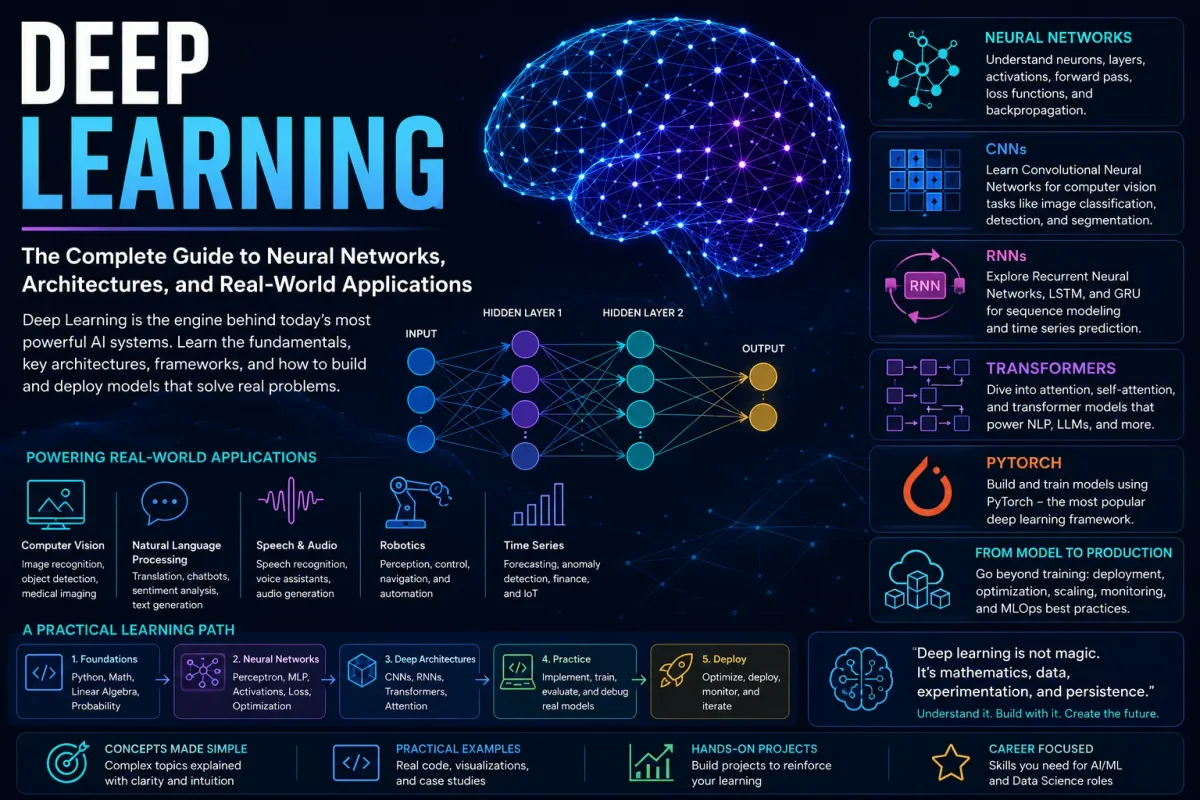
Deep learning is a branch of machine learning built around neural networks with multiple layers. It has become one of the central technologies behind modern computer vision, speech recognition, language models, recommendation systems, and many generative AI applications.
The important part is not the word “deep.”
Deep learning matters because neural networks can learn useful representations directly from large amounts of data. Instead of requiring a person to manually specify every feature that matters, a sufficiently capable neural network can learn increasingly useful patterns through training.
PyTorch’s official documentation describes deep learning workflows around data, models, optimization, automatic differentiation, and training. Its current beginner path walks through tensors, datasets and data loaders, model construction, autograd, optimization, and saving and loading models. (PyTorch — Learn the Basics)
For someone who has completed the fundamentals of machine learning, deep learning is the next major step. But it should not be approached as a collection of mysterious architectures.
The real goal is to understand how a neural network represents information, how it learns, why training fails, how to evaluate it, and how to turn a trained model into a reliable system.
This guide explains those ideas from the ground up and gives you a practical path for learning deep learning in 2026.
What Is Deep Learning?
Deep learning is a form of machine learning that uses neural networks composed of multiple layers of interconnected computational units.
A traditional machine learning workflow often depends on manually designed features:
Raw Data
   ↓
Feature Engineering
   ↓
Machine Learning Model
   ↓
Prediction
Deep learning can learn useful representations from raw or relatively lightly processed data:
Raw Data
   ↓
Neural Network
   ↓
Learned Representations
   ↓
Prediction
The distinction is not absolute. Modern machine learning systems can combine manual features, learned representations, and many other components.
But representation learning is one of the defining strengths of deep learning.
For an image-recognition system, for example, early layers may learn simple visual patterns while later layers combine those patterns into increasingly complex representations.
A simplified progression might look like:
Pixels
  ↓
Edges
  ↓
Textures
  ↓
Shapes
  ↓
Objects
  ↓
Prediction
The actual internal representations are more complex than this diagram suggests, but the idea is useful: a network can construct representations that become increasingly relevant to the task.
How Deep Learning Fits Into AI
Deep learning sits inside the larger AI and machine learning hierarchy:
Artificial Intelligence
        ↓
Machine Learning
        ↓
Deep Learning
        ↓
Neural Networks
Generative AI and foundation models often depend heavily on deep learning, but not every AI system is a deep learning system.
This distinction matters because deep learning is a technique, not a synonym for AI.
A rules-based system can be AI without machine learning.
A linear regression model can be machine learning without deep learning.
A transformer language model is a deep learning system.
Understanding these relationships gives you a better mental model of the field.
Why Deep Learning Became So Powerful
Deep learning did not become successful because neural networks suddenly became a new idea.
Neural networks have existed for decades.
The modern deep learning era was enabled by several developments coming together:
- larger datasets
- more powerful computing hardware
- improved training techniques
- better neural network architectures
- specialized accelerators such as GPUs
- software frameworks that make large-scale experimentation practical
Today, deep learning models can contain enormous numbers of parameters and can be trained on very large datasets.
Stanford’s 2026 AI Index reports that AI capability continues to accelerate, with industry producing more than 90% of notable frontier models in 2025 and leading systems showing major gains across language, multimodal reasoning, coding, and other capabilities. (Stanford HAI — 2026 AI Index)
The lesson for learners is important:
deep learning is not only an academic topic anymore. It is part of the engineering stack behind some of the most capable software systems being built today.
What Is a Neural Network?
A neural network is a computational model made from layers of connected units.
At a simplified level:
Input Layer
     ↓
Hidden Layer
     ↓
Hidden Layer
     ↓
Output Layer
Each connection contains learnable parameters, and each layer transforms its input.
A basic layer can be represented conceptually as:
z = Wx + bwhere:
xis the inputWis a matrix of weightsbis a bias termzis the resulting value before the activation function
PyTorch’s documentation describes neural networks in terms of layers/modules that perform operations on data, with torch.nn providing the building blocks for constructing networks. (PyTorch — Building the Neural Network)
On its own, a linear transformation is limited.
This is where activation functions become important.
Activation Functions
Activation functions introduce non-linearity into a neural network.
Without non-linear activations, stacking many linear transformations would still result in a linear transformation, limiting what the network could represent.
Common activation functions include:
- ReLU
- sigmoid
- tanh
- softmax
- GELU
ReLU
ReLU, or Rectified Linear Unit, is one of the most common activation functions in neural networks:
ReLU(x) = max(0, x)It keeps positive values and maps negative values to zero.
ReLU became popular because it is simple and generally works well in many neural network architectures.
Sigmoid
The sigmoid function maps a value into the range from 0 to 1:
σ(x) = 1 / (1 + e^-x)It is useful in some binary classification contexts, although modern architectures often use other choices internally.
Softmax
Softmax converts a collection of scores into values that can be interpreted as a probability distribution across classes.
For a multiclass classifier, it can turn raw model outputs into class probabilities.
Understanding activation functions helps you understand what individual layers are actually doing rather than treating a neural network as a black box.
Forward Propagation
During a forward pass, data moves through the network from the input toward the output.
For example:
Input
 ↓
Linear Layer
 ↓
Activation
 ↓
Linear Layer
 ↓
Activation
 ↓
Output
Suppose you’re building an image classifier.
The input may be an image tensor.
The network transforms that tensor through multiple layers until it produces scores for the possible classes.
The forward pass answers:
Given the current model parameters, what does the network predict for this input?
The parameters are adjusted during training so that future predictions become better.
Loss Functions
The network needs a way to measure how far its prediction is from the desired output.
That’s the role of a loss function.
Conceptually:
Prediction
     ↓
Compare with target
     ↓
Loss
A lower loss generally indicates that the model’s predictions are closer to what the training objective wants.
Different tasks use different losses.
Examples include:
- mean squared error for many regression problems
- cross-entropy loss for common classification tasks
- specialized objectives for ranking, detection, generation, and other tasks
Choosing a suitable loss function is part of defining what you want the model to learn.
Backpropagation: How Neural Networks Learn
Backpropagation is one of the most important concepts in deep learning.
It provides an efficient way to calculate how the loss changes with respect to the model’s parameters.
The basic training loop is:
Input
  ↓
Forward Pass
  ↓
Prediction
  ↓
Loss
  ↓
Backpropagation
  ↓
Gradients
  ↓
Parameter Update
  ↓
Repeat
The term “backpropagation” can sound complicated, but the core idea is straightforward.
The model makes a prediction.
The loss function measures the error.
Backpropagation calculates how each learnable parameter contributed to that error.
An optimizer then uses those gradients to update the parameters.
PyTorch provides automatic differentiation through its autograd system, allowing gradients to be calculated automatically for the operations involved in a computation. The official beginner workflow places automatic differentiation between model construction and optimization. (PyTorch — Learn the Basics)
Gradient Descent
A common optimization approach is gradient descent.
The basic idea is to adjust parameters in a direction that reduces the loss.
A simplified update looks like:
parameter_new
=
parameter_old
-
learning_rate × gradient
The gradient tells you the direction in which the loss changes.
The learning rate controls how large the update is.
If the learning rate is too large, training can become unstable.
If it is too small, training may become painfully slow.
That small equation is behind an enormous amount of modern neural network training.
Optimizers
Optimizers implement strategies for updating model parameters.
Common optimizers include:
- SGD
- Momentum-based SGD
- Adam
- AdamW
They differ in how they use gradients and adjust parameters.
Adam became popular because it often works well with relatively little tuning across many tasks.
AdamW is also widely used in modern deep learning because it handles weight decay differently from standard Adam.
The important thing for a beginner is not to memorize which optimizer is “best.”
Learn what an optimizer does and why its hyperparameters matter.
Epochs, Batches, and Iterations
Deep learning models are usually trained using batches rather than processing the entire dataset in one operation.
Batch
A batch is a subset of training examples processed together.
Iteration
One iteration generally corresponds to one parameter update based on one batch.
Epoch
One epoch means the training process has gone through the training dataset once.
A simplified training loop looks like:
For each epoch:
    For each batch:
        Make prediction
        Calculate loss
        Calculate gradients
        Update parameters
Training for more epochs is not automatically better.
A model can begin to overfit if it continues optimizing against the training dataset without improving generalization.
This is why validation performance matters.
Training and Validation Curves
One of the best ways to understand what a neural network is doing is to plot training and validation metrics over time.
For example:
Loss
 ^
 |\
 | \
 |  \        validation
 |   \_______/----
 |
 |    training
 |     \__________
 +----------------------> Epoch
The exact shape will vary.
What matters is the relationship between the curves.
A large gap between training and validation performance can be a sign that the model is not generalizing well.
Learning to diagnose these curves is much more valuable than blindly increasing model size.
Overfitting in Deep Learning
Deep neural networks can contain huge numbers of parameters.
That gives them enormous representational power, but it also creates opportunities for overfitting.
Common methods used to improve generalization include:
- collecting more useful data
- data augmentation
- regularization
- dropout
- weight decay
- early stopping
- reducing model complexity when appropriate
There is no universal fix.
The right response depends on the dataset, architecture, objective, and training behavior.
What Is a Convolutional Neural Network?
A Convolutional Neural Network (CNN) is a neural network architecture designed to work particularly well with spatial data such as images.
CNNs use convolutional operations that allow the network to learn local patterns.
A simplified progression might be:
Image
  ↓
Convolution
  ↓
Activation
  ↓
Pooling / Downsampling
  ↓
More Convolution Blocks
  ↓
Classifier
  ↓
Prediction
Early layers may learn simple visual structures.
Later layers can combine those patterns into more complex representations.
CNNs have been influential in:
- image classification
- object detection
- image segmentation
- medical imaging
- visual inspection
- autonomous systems
Even when newer architectures are used, learning CNNs remains valuable because they teach important ideas about receptive fields, feature extraction, hierarchical representations, and spatial structure.
What Are Recurrent Neural Networks?
Recurrent Neural Networks (RNNs) were designed to process sequential information.
They maintain a form of hidden state that is updated as new elements of a sequence arrive.
A simple mental model is:
Input 1 → State 1
             ↓
Input 2 → State 2
             ↓
Input 3 → State 3
             ↓
Output
RNNs and related architectures such as LSTMs and GRUs were historically important in:
- language modeling
- speech processing
- time-series forecasting
- sequence classification
However, modern large-scale language systems are dominated by transformer-based architectures.
RNNs are still worth learning because they provide useful historical and conceptual context for sequence modeling.
Transformers: The Architecture Behind Modern AI
Transformers changed deep learning dramatically.
They became central to modern language models and have also been adapted to vision, audio, multimodal systems, and other domains.
The central idea is attention.
Instead of processing a sequence only one element at a time, attention allows the model to consider relationships between different elements of the input.
A simplified representation is:
Tokens
  ↓
Embeddings
  ↓
Self-Attention
  ↓
Feed-Forward Network
  ↓
Repeated Transformer Blocks
  ↓
Output
Transformers are one of the most important architectures to understand if your long-term goal is AI engineering or work with large language models.
But don’t jump straight into implementing a large transformer.
First understand:
- vectors
- matrices
- neural network layers
- activation functions
- loss functions
- gradients
- optimization
- sequence representations
Then attention becomes much easier to understand.
Deep Learning and Generative AI
Modern generative AI is heavily dependent on deep learning.
Large language models are trained neural networks that learn statistical patterns in very large collections of data and can generate sequences such as text or code.
Other generative systems can work with:
- images
- audio
- video
- speech
- multimodal inputs and outputs
This means deep learning is a foundation for learning modern AI systems.
If you want to understand LLMs rather than merely call an LLM API, deep learning is one of the strongest foundations you can build.
Why PyTorch Is Important
You can learn neural networks without PyTorch.
But eventually, you will need a framework that lets you build, train, evaluate, save, and deploy models efficiently.
PyTorch is one of the major frameworks used for deep learning.
Its current beginner documentation covers the full workflow from tensors and datasets to model construction, automatic differentiation, optimization, and model saving/loading. (PyTorch — Learn the Basics)
PyTorch’s torch.nn package provides the building blocks for defining neural networks, with neural networks represented as modules composed of layers and other modules. (PyTorch — Defining a Neural Network)
A good learning sequence is:
Python
  ↓
NumPy
  ↓
Machine Learning
  ↓
PyTorch Tensors
  ↓
Datasets & DataLoaders
  ↓
Neural Networks
  ↓
Autograd
  ↓
Training Loops
  ↓
Evaluation
  ↓
Deployment
The official PyTorch beginner material now includes these building blocks as a structured learning path. (PyTorch — Learn the Basics)
The Core PyTorch Concepts to Learn
You do not need to memorize the entire framework.
Focus on the concepts that map directly to deep learning fundamentals.
Tensors
Tensors are the primary data structure used by PyTorch.
You’ll encounter tensors everywhere:
- images
- embeddings
- model parameters
- batches
- predictions
Datasets and DataLoaders
These provide a practical way to organize and feed training data into a model.
nn.Module
This is the foundation for defining neural network models in PyTorch.
Autograd
PyTorch’s automatic differentiation system calculates gradients required for optimization.
Optimizers
These update model parameters based on gradients.
Training and Evaluation Modes
You need to understand the difference between training and evaluation behavior for models containing components such as dropout and batch normalization.
Saving and Loading
A trained model needs to be saved and loaded correctly before it can become part of an application.
These concepts are more important than memorizing API calls.
What Should You Learn Before Deep Learning?
Deep learning becomes much easier when the prerequisites are in place.
Python
You should be comfortable writing and debugging Python programs.
NumPy and Data Handling
You should understand arrays, shapes, indexing, broadcasting, and basic numerical operations.
Machine Learning
Know:
- training
- validation
- testing
- loss
- metrics
- overfitting
- regularization
- generalization
Mathematics
Focus on:
- linear algebra
- derivatives
- gradients
- probability
- basic statistics
You don’t need to become a mathematician first.
Learn the mathematics as you need it to understand the models.
A Practical Deep Learning Learning Path
A strong progression looks like:
1. Python
   ↓
2. NumPy + Data Handling
   ↓
3. Machine Learning Fundamentals
   ↓
4. Linear Algebra + Calculus
   ↓
5. Neural Network Basics
   ↓
6. Forward Propagation
   ↓
7. Loss Functions
   ↓
8. Backpropagation
   ↓
9. Gradient Descent
   ↓
10. PyTorch
   ↓
11. Feed-Forward Networks
   ↓
12. CNNs
   ↓
13. Sequence Models
   ↓
14. Attention
   ↓
15. Transformers
   ↓
16. Generative AI
   ↓
17. Deployment and Optimization
Don’t treat this as a rigid checklist.
Some concepts should be revisited multiple times.
For example, you may first learn backpropagation conceptually, then understand the mathematics, then see it through PyTorch autograd, and finally inspect gradients while debugging a model.
That’s normal.
What Should You Build?
Deep learning becomes much easier once you start experimenting.
Beginner Projects
Start with projects that let you understand the complete training process.
Examples:
- handwritten digit classifier
- Fashion-MNIST classifier
- simple binary image classifier
- tabular neural network
- basic text classifier
Intermediate Projects
Move toward more realistic data.
Examples:
- image classification system
- object classification API
- sentiment analysis model
- image captioning prototype
- time-series forecasting model
- document classification system
Advanced Projects
At the advanced level, focus on complete systems.
Examples:
- computer vision API
- document intelligence platform
- multimodal search system
- RAG application
- transformer-based application
- model serving platform
- model monitoring pipeline
For every project, document:
Problem
Dataset
Architecture
Training Process
Evaluation
Errors
Limitations
Deployment
Future Improvements
That documentation is part of the engineering work.
Train a Small Model Before Using a Huge One
This advice gets ignored constantly.
Beginners often want to start with a massive model because large models are impressive.
That makes learning harder.
A small neural network lets you see the entire system:
Dataset
   ↓
Tensor
   ↓
Model
   ↓
Forward Pass
   ↓
Loss
   ↓
Backward Pass
   ↓
Optimizer
   ↓
Updated Parameters
You can run experiments quickly.
You can intentionally break the training loop.
You can inspect gradients.
You can change the learning rate.
You can visualize the loss.
You can understand what each component does.
Once those ideas are familiar, larger models become easier to reason about.
Common Deep Learning Mistakes
Jumping directly into Transformers
Transformers are important, but skipping neural network fundamentals leaves major gaps.
Memorizing PyTorch APIs
Knowing that an API exists is not the same as understanding the computation it performs.
Ignoring tensor shapes
Tensor-shape mistakes are among the most common practical problems when learning deep learning.
Get comfortable asking:
What is the shape?
What does each dimension represent?
What shape does the next layer expect?
Training without a validation set
Training loss alone does not tell you whether the model generalizes.
Changing everything at once
If you change the architecture, optimizer, learning rate, batch size, and dataset simultaneously, you cannot tell what caused the result.
Change one important variable at a time.
Using a large model when a small model is enough
More parameters do not automatically mean a better solution.
Ignoring data quality
A deep neural network cannot magically correct mislabeled or systematically biased data.
How to Debug a Neural Network
When a model doesn’t work, resist the temptation to immediately change the architecture.
Use a systematic process.
Step 1: Check the data
Look at actual examples.
Check:
- labels
- shapes
- missing values
- normalization
- class balance
Step 2: Check the model
Print the model structure.
Verify:
- input dimensions
- output dimensions
- activation functions
- expected tensor shapes
Step 3: Overfit a Tiny Dataset
This is one of the most useful debugging techniques.
Take a very small subset of the training data.
If the model cannot learn even that tiny dataset, something may be wrong with:
- the model
- labels
- loss function
- optimizer
- learning rate
- data pipeline
Step 4: Inspect the Training Curve
Plot training and validation loss.
Step 5: Inspect Predictions
Don’t look only at a single accuracy number.
Look at actual mistakes.
Error analysis often reveals problems that a metric hides.
Deep Learning Is Not Just About Bigger Models
There is a persistent misunderstanding that progress in deep learning is simply:
Bigger dataset
+
Bigger model
+
More GPUs
=
Better AI
Scale matters.
But real systems also depend on:
- architecture
- data quality
- optimization
- evaluation
- inference cost
- latency
- reliability
- security
- monitoring
The 2026 AI Index notes that leading AI systems are increasingly capable, while evaluation and governance are becoming more important as benchmark performance advances faster. (Stanford HAI — 2026 AI Index)
For engineers, that means understanding the complete system is becoming more valuable.
Deep Learning in Production
Training a model is one phase.
Production is another.
A production deep learning system may look like:
User / Application
       ↓
API
       ↓
Preprocessing
       ↓
Model
       ↓
Postprocessing
       ↓
Response
       ↓
Logging + Monitoring
You may also need:
- model versioning
- data versioning
- experiment tracking
- latency monitoring
- GPU/CPU optimization
- batching
- caching
- quantization
- security controls
- rollback strategies
PyTorch’s current tutorial ecosystem includes dedicated material for profiling and model optimization techniques such as quantization and pruning, showing that performance becomes a separate engineering concern after basic model training. (PyTorch Deep Dive)
This is where deep learning starts connecting directly to AI engineering.
Should You Learn CNNs, RNNs, and Transformers?
Yes, but understand why you’re learning them.
CNNs
Learn them to understand spatial representations and computer vision.
RNNs and LSTMs
Learn them primarily for sequence-modeling concepts and historical context.
Transformers
Learn them deeply if your goal includes modern language models, generative AI, multimodal AI, or AI engineering.
You don’t need equal expertise in every architecture.
Your specialization can develop later.
What Is the Best Way to Learn Deep Learning?
Use a cycle that combines theory and implementation:
Concept
  ↓
Math
  ↓
Small Implementation
  ↓
PyTorch Implementation
  ↓
Experiment
  ↓
Evaluation
  ↓
Project
  ↓
Explain What Happened
For example, when learning a neural network:
First understand what a layer does.
Then understand the matrix multiplication.
Then understand the activation function.
Then implement a tiny network.
Then build it in PyTorch.
Then train it.
Then inspect its predictions.
Then deliberately change the learning rate and observe what happens.
That is much more valuable than watching twenty hours of architecture diagrams without building anything.
How Deep Should You Go?
That depends on your goal.
AI Application Engineer
You need enough deep learning knowledge to understand model behavior, evaluate models, integrate them into systems, and work with APIs or pretrained models.
Machine Learning Engineer
You need deeper knowledge of training pipelines, model development, evaluation, deployment, and optimization.
AI Researcher
You need substantially deeper mathematics, optimization, papers, experimental design, and research methodology.
AI-Focused Software Engineer
You need a strong combination:
Software Engineering
       +
Machine Learning
       +
Deep Learning
       +
Systems
       +
AI Applications
For most aspiring engineers, this is a strong long-term direction.
Frequently Asked Questions
Is deep learning the same as machine learning?
No.
Deep learning is a subfield of machine learning focused primarily on neural networks with multiple layers.
Do I need machine learning before deep learning?
For a strong foundation, yes.
You can technically start deep learning immediately, but understanding classical ML concepts such as loss, evaluation, overfitting, and generalization will make deep learning much easier.
Do I need a powerful GPU to learn deep learning?
No.
You can learn many fundamentals using a CPU or free/cloud computing environments.
The objective at the beginning is understanding, not training enormous models.
Should I learn TensorFlow or PyTorch?
Both are important frameworks, but you do not need to master both initially.
PyTorch is a strong choice for learning because its current official beginner path covers tensors, datasets, models, autograd, optimization, and saving/loading models in a coherent workflow. (PyTorch — Learn the Basics)
Should I learn transformers before CNNs?
Not necessarily.
Learn the architecture that matches your goals, but understand neural-network fundamentals first.
If you plan to specialize in LLMs and generative AI, transformers should eventually become a major focus.
Can I learn deep learning without understanding backpropagation?
You can use deep learning frameworks without understanding it.
But for serious technical understanding, you should learn what backpropagation does and why gradients are needed.
Should I build projects while learning deep learning?
Absolutely.
A small, working classifier can teach you more about the training loop than passively reading about it for days.
Final Thoughts
Deep learning can look intimidating because the field contains enormous models, unfamiliar mathematics, GPUs, transformers, and rapidly changing research.
The underlying training loop is much simpler than the modern ecosystem makes it appear:
Data
 ↓
Prediction
 ↓
Loss
 ↓
Gradients
 ↓
Parameter Update
 ↓
Repeat
Master that idea.
Then understand layers.
Then activations.
Then optimization.
Then architectures.
Then transformers.
Then modern AI systems.
The goal is not to memorize every neural-network architecture that has ever been published.
The goal is to understand why these systems work, how they fail, how to train them, how to evaluate them, and how to build useful software around them.
Once you can do that, modern AI stops looking like magic.
It becomes engineering.
Where to Go Next
After building a solid deep learning foundation, the natural next step for modern AI is Large Language Models (LLMs).
The AI Career Guide learning sequence is:
Artificial Intelligence → Machine Learning → Deep Learning → LLMs → AI Engineering
And throughout the process:
Learn → Implement → Experiment → Build → Evaluate → Deploy
That is the path from understanding neural networks to building real AI systems.
Sources
- PyTorch — Learn the Basics
- PyTorch — Build the Neural Network
- PyTorch — Defining a Neural Network
- PyTorch — Deep Learning with PyTorch: A 60 Minute Blitz
- PyTorch — Deep Dive
- Stanford HAI — 2026 AI Index Report
Continue the path
Keep building from here
Artificial Intelligence Explained: How AI Works
Understand AI, machine learning, deep learning, and generative AI, then follow a practical path to build a strong AI foundation.
Machine Learning: How It Works and How to Learn It
Learn machine learning from fundamentals to projects: models, evaluation, overfitting, algorithms, Python, and a practical learning path.
AI Engineer Roadmap
A practical AI engineer roadmap covering software engineering, math, ML, deep learning, LLMs, deployment, evaluation, and career preparation.
AI Research Assistant
Build an LLM research assistant with document search, evidence retrieval, grounded summaries, source comparison, and citations.
Practical Deep Learning for Coders
A practical course centered on building and training deep learning systems with a strong implementation focus.
Hands-On Machine Learning
A practical reference for machine learning with Python, scikit-learn, deep learning, and modern ML workflows.