
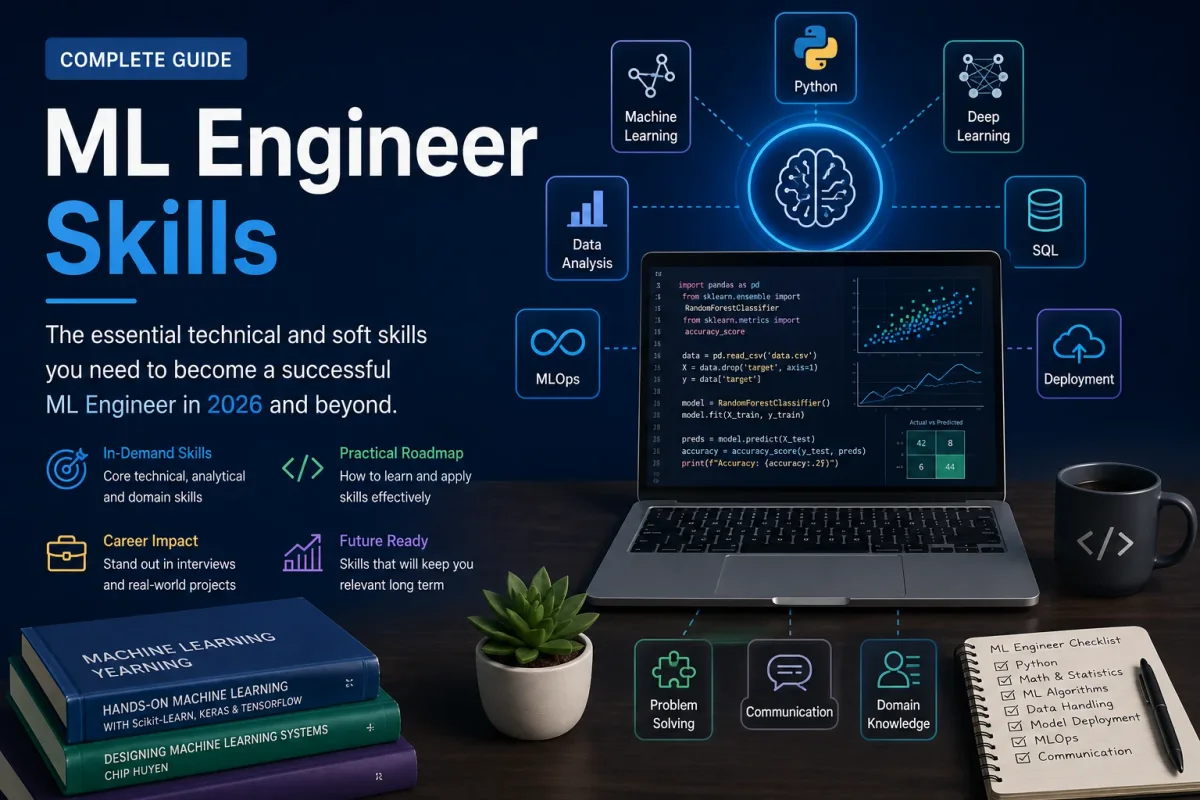
Machine learning engineering is not just about training models.
A strong ML engineer has to understand data, build reliable software, choose and evaluate models, deploy them, monitor what happens in production, and communicate technical decisions clearly. That is why the role sits at the intersection of machine learning, software engineering, data, and systems.
This guide breaks down the most important ML engineer skills to develop, what each skill is used for, and what “good enough” looks like when you are preparing for real projects and jobs.
A practical ML engineer skill set can be grouped into eight areas:
- Programming and software engineering
- Mathematics and statistics
- Data handling and SQL
- Machine learning
- Deep learning
- Deployment and MLOps
- Problem-solving and system thinking
- Communication and domain knowledge
You do not need to master every topic at once. The goal is to build these skills in layers and connect them through projects.
1. Python and Software Engineering
Python
Python is one of the most important languages for machine learning work because the ecosystem around data science, ML, deep learning, and deployment is extensive.
You should be comfortable with:
- Functions, classes, modules, and packages
- Exception handling
- File and API handling
- Virtual environments and dependency management
- Type hints
- Logging
- Testing
- Writing reusable code
- Git and GitHub
Knowing syntax is not enough. A production ML project should not look like one giant notebook.
A good progression is:
Python fundamentals → OOP → packages → testing → APIs → production project structure
Software Engineering Fundamentals
ML systems are still software systems.
You should understand:
- Clean code
- Separation of concerns
- Configuration management
- Unit and integration testing
- Git workflows
- Code review
- Debugging
- Basic design patterns
- REST APIs
- Documentation
This becomes especially important when your model is consumed by another application.
Your AI Engineering guide is a useful next step for understanding the software side of AI systems.
2. Mathematics and Statistics
You do not need to become a mathematician, but you do need enough mathematical understanding to reason about models instead of treating libraries as black boxes.
Linear Algebra
Focus on:
- Vectors
- Matrices
- Matrix multiplication
- Dot products
- Norms
- Eigenvalues and eigenvectors
- Basic transformations
These concepts appear everywhere in machine learning and deep learning.
Probability and Statistics
You should understand:
- Probability distributions
- Conditional probability
- Mean, variance, and standard deviation
- Covariance and correlation
- Sampling
- Hypothesis testing
- Confidence intervals
- Bayes’ theorem
- Bias and variance
Statistics also helps you understand whether a model improvement is meaningful or just noise.
Calculus and Optimization
At minimum, learn:
- Derivatives
- Partial derivatives
- Gradients
- Chain rule
- Gradient descent
You do not need to memorize pages of formulas. You should be able to explain what an optimization algorithm is doing.
For a broader view of the field, see the Machine Learning guide.
3. Data Handling and SQL
A large part of ML engineering is data work.
Before a model can learn, you have to make sure the data is usable.
Data Skills
You should know how to:
- Load and inspect datasets
- Clean missing values
- Handle outliers
- Encode categorical variables
- Scale numerical features when appropriate
- Detect data leakage
- Split data correctly
- Build reproducible preprocessing pipelines
- Perform exploratory data analysis
Python libraries such as NumPy, pandas, and scikit-learn should become practical tools rather than libraries you only know by name.
SQL
SQL is one of the most useful supporting skills for ML engineers.
Learn:
- SELECT and filtering
- JOINs
- GROUP BY
- Aggregations
- Subqueries
- Common table expressions
- Window functions
- Basic query optimization
Many real ML tasks begin with a database query, not a model.
A model trained on clean data is not useful if the data pipeline feeding it is unreliable.
4. Core Machine Learning
This is the central technical skill.
You should understand both how models work and when to use them.
Supervised Learning
Learn the intuition and implementation of:
- Linear regression
- Logistic regression
- Decision trees
- Random forests
- Gradient boosting
- Support vector machines
- k-nearest neighbors
Unsupervised Learning
Understand:
- Clustering
- Dimensionality reduction
- Anomaly detection
- Feature discovery
Model Evaluation
A strong ML engineer does not stop at training accuracy.
You should know when and why to use:
- Accuracy
- Precision
- Recall
- F1-score
- ROC-AUC
- PR-AUC
- Mean absolute error
- Mean squared error
- Root mean squared error
More importantly, understand the business meaning behind a metric.
For example, a fraud detection system may prefer high recall, while a system that triggers an expensive manual review may prioritize precision.
Feature Engineering
Learn to turn raw information into useful model inputs.
Important areas include:
- Numerical transformations
- Categorical encoding
- Date and time features
- Text features
- Interaction features
- Feature selection
- Data leakage prevention
The Machine Learning topic page is useful for building this part of your foundation systematically.
5. Deep Learning
Not every ML engineer needs advanced deep learning immediately, but modern AI work often requires it.
Learn the fundamentals of:
- Neural networks
- Forward propagation
- Backpropagation
- Activation functions
- Loss functions
- Optimizers
- Regularization
- Batch normalization
- Dropout
Then move into architectures relevant to your direction:
- CNNs for computer vision
- RNNs and sequence models for historical context
- Transformers for modern language and multimodal systems
You should also gain practical experience with a framework such as PyTorch.
The goal is not to collect knowledge of many frameworks. Build enough depth with one framework to train, debug, evaluate, and save models confidently.
For a deeper progression, read the Deep Learning guide.
6. Deployment and MLOps
This is where many beginners stop too early.
Training a model in a notebook is only one stage of ML engineering.
A production system may need:
Data → preprocessing → training → validation → model registry → API/service → deployment → monitoring → retraining
Deployment Skills
Learn the basics of:
- REST APIs
- FastAPI or a similar Python API framework
- Docker
- Environment variables
- Linux
- Cloud fundamentals
- Model serialization
- Basic networking
You should be able to take a trained model and expose it through an API that another application can use.
MLOps
MLOps is the engineering discipline around reliable machine learning workflows.
Key concepts include:
- Experiment tracking
- Data versioning
- Model versioning
- Continuous integration and delivery
- Automated training pipelines
- Monitoring
- Drift detection
- Reproducibility
- Rollbacks
You do not need a huge MLOps stack for your first project.
Start simple:
Git → tests → Docker → API → deployment → logging → monitoring
Then add more advanced tooling as your projects demand it.
7. Cloud and Infrastructure Fundamentals
You do not need to become a cloud specialist to become an ML engineer, but you should understand how your systems run.
Learn the fundamentals of at least one cloud platform:
- Compute
- Storage
- Databases
- Networking
- IAM
- Containers
- Monitoring
More important than memorizing cloud products is understanding the architecture.
For example:
Where does the model run?
Where is the data stored?
How does the application call the model?
How are secrets managed?
How do you monitor failures?
These questions matter far more than memorizing hundreds of service names.
8. Problem-Solving and System Thinking
This skill is easy to underestimate.
Real ML engineering rarely gives you a perfectly defined problem. You may receive a vague request such as:
“Can we use machine learning to reduce customer churn?”
Before building anything, you need to turn that request into an engineering problem.
Ask:
- What exactly are we predicting?
- What data is available?
- What is the target variable?
- What baseline should we compare against?
- What metric matters?
- What is the cost of false positives and false negatives?
- How will the model be used?
- What happens when the model is wrong?
This is where system thinking becomes valuable.
The best ML engineer is not necessarily the person who knows the most algorithms. It is often the person who can choose the simplest reliable solution for the actual problem.
9. Communication and Documentation
ML engineers work with people from different backgrounds.
You may need to explain a model to:
- Software engineers
- Product managers
- Data analysts
- Business teams
- Executives
- Clients
Learn to communicate:
- What the model does
- What data it uses
- How it is evaluated
- What its limitations are
- What changed between versions
- Why a particular approach was selected
Good documentation also matters.
A useful ML project should explain:
- Problem statement
- Dataset
- Features
- Training process
- Evaluation
- Deployment
- Known limitations
- Reproduction steps
Technical ability gets you into the conversation. Clear communication makes people trust your work.
10. Domain Knowledge
Machine learning does not happen in a vacuum.
A model for healthcare, finance, manufacturing, recommendation systems, and cybersecurity can have very different requirements.
Domain knowledge helps you understand:
- Which data is meaningful
- Which errors are expensive
- What constraints exist
- What users actually need
- What metrics matter
You do not need to know every industry. Pick one or two problem areas that interest you and build projects around real use cases.
The ML Engineer Skill Stack
A useful way to visualize the skill stack is:
                    ML ENGINEER
                         |
        +----------------+----------------+
        |                |                |
   Machine Learning  Software         Data
        |            Engineering         |
   Algorithms       Python/Git       SQL/pandas
   Evaluation       APIs/Testing     Pipelines
        |
   Deep Learning
        |
   PyTorch / Models
        |
   Production Engineering
        |
 Deployment / Docker / Cloud / MLOps
        |
   Problem Solving + Communication
The important point is that these are connected skills, not isolated subjects.
What Skills Should You Learn First?
Do not try to learn everything simultaneously.
A practical order is:
Stage 1: Programming Foundation
Learn:
- Python
- Git/GitHub
- NumPy
- pandas
- SQL
- Basic Linux
Then build small data projects.
Stage 2: Machine Learning Foundation
Learn:
- Statistics
- Regression
- Classification
- Trees and ensembles
- Feature engineering
- Model evaluation
- Cross-validation
Build several complete ML projects.
Stage 3: Engineering
Add:
- Testing
- APIs
- FastAPI
- Docker
- Project structure
- Logging
Take one existing ML project and turn it into a usable service.
Stage 4: Deep Learning
Learn:
- Neural networks
- PyTorch
- CNNs
- Transformers
- Training and evaluation
Build at least one serious deep learning project.
Stage 5: Production and MLOps
Learn:
- Deployment
- Cloud fundamentals
- CI/CD
- Experiment tracking
- Monitoring
- Model versioning
At this stage, your projects start to look much closer to real engineering systems.
Skills That Matter Most in ML Engineer Interviews
Interview preparation should not be limited to ML theory.
Expect a mix of:
Coding
- Data structures and algorithms
- Python programming
- Debugging
- Complexity analysis
Machine Learning
- Bias vs. variance
- Overfitting
- Regularization
- Model selection
- Feature engineering
- Evaluation metrics
Statistics
- Probability
- Distributions
- Sampling
- Hypothesis testing
ML System Design
- Data pipelines
- Training workflows
- Batch vs. real-time inference
- Model serving
- Monitoring
- Scalability
Projects
Be ready to explain one project deeply:
- Why you built it
- What data you used
- What baseline you started with
- Why you selected the model
- What failed
- How you evaluated it
- How you deployed it
- What you would improve next
Your AI Engineer Interview Questions article can help you prepare beyond algorithm memorization.
Common Mistakes While Learning ML Engineering
Learning too many tools
You do not need ten cloud platforms, five deep learning frameworks, and every MLOps product.
Depth beats tool collecting.
Staying inside notebooks
Notebooks are useful for exploration. They should not be the final form of every project.
Move important logic into reusable Python modules.
Ignoring software engineering
A model with good accuracy can still be a poor engineering solution.
Ignoring deployment
A project is much stronger when another person can actually use it.
Building projects without understanding the problem
Do not build another generic Titanic classifier just because a tutorial does.
Pick a real problem and define a meaningful evaluation strategy.
How to Prove You Have These Skills
The strongest way to demonstrate ML engineering skills is through projects.
A good portfolio progression could be:
Project 1: Classical ML
Build a prediction system with:
- Data cleaning
- Feature engineering
- Model comparison
- Evaluation
- Clear documentation
Project 2: End-to-End ML Application
Add:
- API
- Frontend or client
- Docker
- Deployment
Project 3: Deep Learning
Build a meaningful application using PyTorch.
Project 4: Production ML System
Add:
- Automated pipeline
- Model versioning
- Monitoring
- Reproducible training
- CI/CD
You can also study the ML Engineer career roadmap to connect these projects with a longer-term learning plan.
ML Engineer Skills Checklist
Before calling yourself job-ready, aim to be able to say “yes” to most of these:
- I can write clean Python.
- I use Git confidently.
- I can work with pandas and NumPy.
- I can write useful SQL queries.
- I understand core statistics.
- I can build and evaluate ML models.
- I understand overfitting and data leakage.
- I can explain why I chose a model.
- I can train a deep learning model.
- I can build a model-serving API.
- I understand Docker.
- I can deploy an ML application.
- I understand basic MLOps concepts.
- I can debug data and model failures.
- I can explain my technical decisions clearly.
- I have built end-to-end projects.
You do not need every box checked before applying for internships. But the more of the stack you can demonstrate through real work, the stronger your profile becomes.
Final Thoughts
The most valuable ML engineer skills are not a random collection of libraries and algorithms.
They form a progression:
Code well → understand data → understand ML → build models → engineer reliable software → deploy it → monitor it → communicate the result.
That progression is much more valuable than rushing through dozens of courses.
Start with the fundamentals, build real systems, and make each project force you to learn the next skill.
For the next step, follow the How to Become an ML Engineer guide and use this article as your skills checklist while you build your portfolio.
Continue the path
Keep building from here
What Is an ML Engineer? Role, Skills, and Career Path
Learn what ML engineers do, the skills they need, how the role differs from AI and software engineering, and how to start.
How to Become an ML Engineer: A Practical Roadmap for 2026
A practical ML engineer roadmap covering Python, math, machine learning, software engineering, projects, deployment, and career preparation.
AI Engineer Roadmap
A practical AI engineer roadmap covering software engineering, math, ML, deep learning, LLMs, deployment, evaluation, and career preparation.
Production-Ready URL Shortener with FastAPI
Build a production-style URL shortener with redirects, analytics, databases, caching, authentication, testing, and deployment.
Hands-On Machine Learning
A practical reference for machine learning with Python, scikit-learn, deep learning, and modern ML workflows.
Practical Deep Learning for Coders
A practical course centered on building and training deep learning systems with a strong implementation focus.