
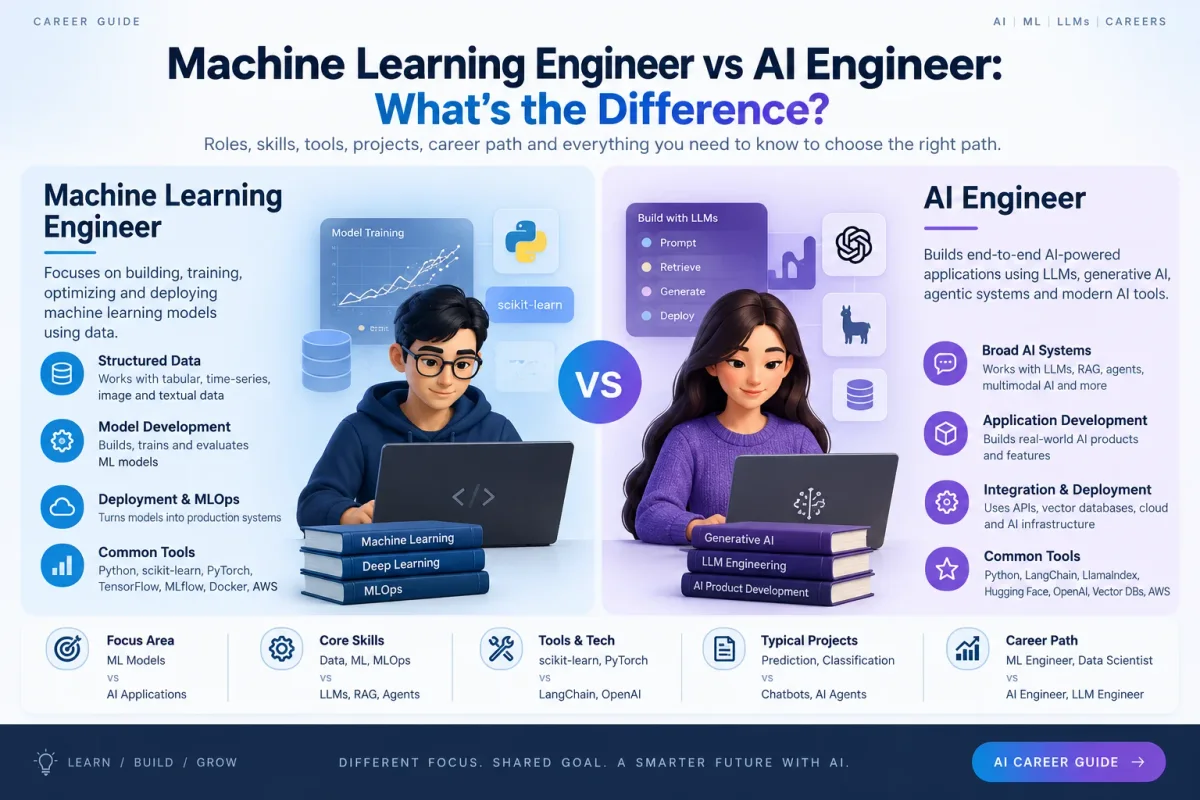
The titles Machine Learning Engineer and AI Engineer are often used interchangeably.
That is understandable. Both roles involve programming, machine learning, data, model deployment, and production systems. Many companies also define the roles differently depending on what they build.
But there is still a useful distinction.
A Machine Learning Engineer typically goes deeper into machine learning models, training pipelines, data, experimentation, and model performance.
An AI Engineer usually works more broadly across the AI application stack, combining models with software engineering, APIs, retrieval, tools, evaluation, infrastructure, and product requirements.
The boundary is not fixed. A strong engineer may do work from both sides.
So the better question is not:
“Which title is better?”
It is:
“What kind of engineering work do I want to become excellent at?”
This guide breaks down the difference in a practical way.
ML Engineer vs AI Engineer at a Glance
| Area | Machine Learning Engineer | AI Engineer |
|---|---|---|
| Primary focus | ML model development and production | AI-powered applications and systems |
| Core work | Training, evaluation, feature pipelines, serving | Integration, orchestration, retrieval, tools, APIs |
| Machine learning | Deep | Strong working knowledge |
| Software engineering | Strong | Strong |
| Deep learning | Important | Important for relevant systems |
| LLMs | Increasingly important | Often central |
| RAG | Useful | Often important |
| MLOps | Very important | Important |
| Backend development | Useful to strong | Often strong |
| System design | Important | Very important |
| Product integration | Moderate to strong | Very important |
| Typical output | Models and ML systems | AI features and complete AI products |
The biggest difference is where the center of gravity sits.
An ML engineer tends to spend more of their time making models and ML pipelines work well.
An AI engineer tends to spend more of their time making AI capabilities work reliably inside a complete software product.
What Does a Machine Learning Engineer Do?
A Machine Learning Engineer turns data and machine learning techniques into production systems.
That can include:
- preparing and validating training data
- building features and pipelines
- selecting algorithms
- training models
- tuning models
- evaluating model performance
- deploying models
- monitoring model behavior
- improving latency and reliability
- maintaining ML infrastructure
A simplified workflow looks like this:
Business Problem
      ↓
Data Collection
      ↓
Data Preparation
      ↓
Feature Engineering
      ↓
Model Training
      ↓
Evaluation
      ↓
Deployment
      ↓
Monitoring
      ↓
Retraining / Improvement
The model is an important part of the job, but the job is not simply “training models.”
A production ML engineer also needs to understand the software and infrastructure surrounding the model.
Typical ML Engineer Projects
Examples include:
- fraud detection
- demand forecasting
- recommendation systems
- customer churn prediction
- ranking systems
- classification pipelines
- computer vision systems
- anomaly detection
- predictive maintenance
For example, an ML engineer working on fraud detection might build a pipeline that processes transaction data, generates features, predicts fraud probability, serves predictions through an API, and monitors model performance after deployment.
That is much closer to real ML engineering than a notebook containing a trained model.
What Does an AI Engineer Do?
An AI Engineer focuses on building software that uses AI capabilities to solve real problems.
This role has become especially broad as modern AI systems have expanded beyond traditional machine learning.
An AI engineer may work with:
- machine learning models
- large language models
- embeddings
- retrieval systems
- APIs
- vector databases
- tools and function calling
- agents
- evaluation pipelines
- backend services
- cloud infrastructure
A typical AI application might look like:
User
 ↓
Frontend
 ↓
Backend API
 ↓
AI Orchestration
 ├── Model
 ├── Retrieval
 ├── Tools
 └── Business Logic
 ↓
Database / External Services
 ↓
Response
The model is only one component.
The engineer is responsible for making the whole system useful and reliable.
Typical AI Engineer Projects
Examples include:
- AI assistants
- document question-answering systems
- RAG applications
- coding assistants
- research assistants
- AI search
- recommendation features
- multimodal applications
- AI agents
- workflow automation
For example, an AI engineer building a research assistant might need to ingest documents, generate embeddings, retrieve relevant passages, call an LLM, enforce permissions, return citations, expose an API, and monitor quality and cost.
That is AI engineering.
The Core Difference: Model-Centric vs System-Centric
This is the simplest way to understand the distinction.
Machine Learning Engineer
The central question is often:
“How do we build and operate a model that performs well?”
AI Engineer
The central question is often:
“How do we build a reliable product or system that uses AI effectively?”
That does not mean an ML engineer ignores software engineering.
And it does not mean an AI engineer avoids machine learning.
The difference is primarily depth and emphasis.
Skills: ML Engineer vs AI Engineer
The skill overlap is large, but the weighting changes.
1. Programming
Both roles need strong programming ability.
Python is particularly useful across the AI/ML ecosystem.
You should be comfortable with:
- functions and modules
- object-oriented programming
- data structures
- testing
- debugging
- package management
- APIs
- logging
- clean code
- Git
For AI and ML work, programming is not a supporting skill. It is the foundation.
A model can be mathematically correct and still be part of a badly engineered system.
2. Machine Learning
This is where the ML engineer generally goes deeper.
An ML engineer should understand:
- supervised learning
- unsupervised learning
- feature engineering
- model selection
- training and validation
- cross-validation
- regularization
- overfitting
- underfitting
- data leakage
- class imbalance
- model metrics
- error analysis
You should be able to answer not only:
“Which model should I use?”
but also:
“Why is this model failing, and what evidence tells me what to change?”
The Machine Learning guide is a useful starting point.
3. Deep Learning
Both roles may need deep learning.
ML engineers often use deep learning when the problem requires it, while AI engineers may use pretrained deep learning models as components of larger systems.
Important concepts include:
- tensors
- neural networks
- loss functions
- backpropagation
- optimization
- CNNs
- attention
- transformers
- transfer learning
For deeper study, see the Deep Learning guide.
4. LLMs and Generative AI
This is increasingly important for AI engineers.
You should understand concepts such as:
- tokenization
- embeddings
- context windows
- attention
- inference
- structured outputs
- tool calling
- streaming
- prompt design
- model selection
- latency
- token usage
- cost
A strong AI engineer should understand the concepts underneath the tools rather than becoming dependent on one provider.
The LLMs guide covers this area in more detail.
5. Retrieval-Augmented Generation
RAG is another area that commonly appears in AI engineering.
A simplified system is:
Documents
    ↓
Chunking
    ↓
Embeddings
    ↓
Vector Store
At query time:
User Question
     ↓
Retriever
     ↓
Relevant Context
     ↓
LLM
     ↓
Answer + Sources
An AI engineer needs to think beyond “connect a vector database.”
A production RAG system also needs:
- ingestion
- metadata
- retrieval evaluation
- ranking
- citations
- access control
- failure handling
- monitoring
For example, your AI Research Assistant project is a natural example of this type of system.
6. MLOps
MLOps is particularly central to the ML engineering path.
It covers the operational side of machine learning:
- experiment tracking
- model versioning
- data versioning
- deployment
- monitoring
- CI/CD
- rollback
- automated evaluation
- reproducibility
An ML engineer should understand what happens after a model leaves the notebook.
A useful progression is:
Experiment
   ↓
Reproducible Training
   ↓
Model Registry
   ↓
Deployment
   ↓
Monitoring
   ↓
Retraining
AI engineers also benefit from these practices, especially when building production AI applications.
7. Backend Engineering
Backend skills are especially valuable for AI engineers.
AI features usually need application infrastructure around them.
That can include:
- REST APIs
- authentication
- authorization
- request validation
- databases
- background jobs
- rate limiting
- streaming
- caching
- error handling
A common AI application stack might look like:
Frontend
   ↓
FastAPI / Backend
   ↓
AI Service
 ├── LLM
 ├── Retrieval
 └── Tools
   ↓
PostgreSQL / Storage
An AI engineer who cannot connect AI capabilities to real software will eventually run into a ceiling.
8. Data and Databases
Both roles use data, but they may interact with it differently.
ML engineers often work deeply with:
- training datasets
- feature pipelines
- labels
- data validation
- batch processing
- data quality
AI engineers may work heavily with:
- application databases
- document stores
- conversation history
- metadata
- user state
- vector search
- logs
- evaluation datasets
SQL remains useful for both.
9. System Design
System design becomes increasingly important as the scale and complexity of the application grows.
An ML engineer might design:
- model-serving infrastructure
- feature pipelines
- training pipelines
- inference systems
- recommendation platforms
An AI engineer might design:
- RAG platforms
- AI assistants
- agent systems
- model gateways
- AI search
- document-processing systems
A useful design process is:
Requirements
    ↓
Scale
    ↓
Data
    ↓
Architecture
    ↓
Model / AI Components
    ↓
Serving
    ↓
Evaluation
    ↓
Monitoring
The important point is that AI system design is not only about choosing a model.
You have to think about latency, reliability, cost, security, failure modes, and user experience.
Tools: Are They Different?
There is significant overlap.
| Area | ML Engineer | AI Engineer |
|---|---|---|
| Python | Essential | Essential |
| SQL | Important | Important |
| Git/GitHub | Essential | Essential |
| Linux | Important | Important |
| scikit-learn | Common | Useful |
| PyTorch | Common | Common |
| TensorFlow | Common in some teams | Useful in some teams |
| MLflow | Common | Useful |
| Docker | Important | Important |
| Cloud | Important | Important |
| FastAPI | Useful | Very useful |
| LLM APIs | Increasingly common | Very common |
| Vector databases | Useful | Common |
| RAG frameworks | Useful | Common |
| Agent frameworks | Emerging | More common |
Do not treat this table as a checklist.
Tools change.
The engineering concepts behind them last much longer.
Day-to-Day Work: How Different Is It?
The difference becomes clearer when you look at what engineers actually do.
A Machine Learning Engineer might spend a day:
- investigating a data-quality problem
- improving feature pipelines
- running experiments
- tuning a model
- analyzing false positives
- optimizing inference
- reviewing an ML pull request
- monitoring production performance
An AI Engineer might spend a day:
- designing an AI workflow
- integrating an LLM API
- improving retrieval
- implementing tool calling
- building an API
- debugging a production failure
- evaluating model outputs
- reducing latency or token costs
- improving an AI feature with product and engineering teams
There is still plenty of overlap.
The difference is where the work tends to concentrate.
Which Role Requires More Math?
Usually, Machine Learning Engineering requires more mathematical depth.
That does not mean AI engineering is “math-free.”
Both benefit from understanding:
- linear algebra
- probability
- statistics
- optimization
- basic calculus
But the depth can differ.
An ML engineer working on model development may need to reason deeply about optimization, loss functions, distributions, model behavior, and experimentation.
An AI engineer integrating pretrained models may spend more time on architecture, APIs, retrieval, evaluation, security, and production engineering.
Your mathematical depth should therefore match the kind of AI work you want to do.
Which Role Requires More Software Engineering?
Both require it.
However, many AI engineering roles place a particularly strong emphasis on application development.
The reason is simple:
AI is only valuable when it works inside a product.
An AI engineer may need to handle:
- frontend-to-backend integration
- APIs
- databases
- authentication
- permissions
- asynchronous jobs
- observability
- deployment
- cloud infrastructure
An ML engineer also needs strong software engineering, especially when building training and serving infrastructure.
The dangerous career mistake is becoming the person who can only make a notebook work.
What About Generative AI?
This is where the modern AI engineer role has expanded significantly.
An ML engineer can certainly work with generative AI.
But many AI engineer roles are specifically centered around:
- LLM applications
- RAG
- multimodal systems
- agentic workflows
- AI automation
- model APIs
- evaluation systems
This creates a useful distinction:
ML Engineer
Model
   ↓
Training
   ↓
Evaluation
   ↓
Serving
versus:
AI Engineer
User Problem
   ↓
AI Application
 ├── Model
 ├── Retrieval
 ├── Tools
 ├── Business Logic
 └── Evaluation
   ↓
Production System
Again, these are tendencies, not rigid definitions.
Which Role Is Better for a Beginner?
There is no universal winner.
But the learning path should usually be more structured than the job titles suggest.
A strong beginner foundation looks like:
Python
   ↓
DSA + Problem Solving
   ↓
Git + Linux + SQL
   ↓
Software Engineering
   ↓
Math + Statistics
   ↓
Machine Learning
   ↓
Deep Learning
   ↓
LLMs + Retrieval
   ↓
APIs + Deployment
   ↓
System Design
This gives you enough foundation to move toward either path.
The AI Engineer roadmap and ML Engineer roadmap can then help you specialize.
How to Choose Between ML Engineer and AI Engineer
Use your preferred type of work as the deciding factor.
Choose ML Engineering if you enjoy:
- experimenting with models
- mathematics and statistics
- feature engineering
- model performance
- training pipelines
- deep learning
- data quality
- optimization
- MLOps
You may enjoy asking:
“How can I make this model more accurate, efficient, robust, or scalable?”
Choose AI Engineering if you enjoy:
- building products
- backend development
- integrating models
- LLM applications
- RAG
- tool calling
- AI agents
- APIs
- system design
- product decisions
You may enjoy asking:
“How can I turn this AI capability into a useful, reliable product?”
What If You Like Both?
That is probably the best position to be in.
A strong engineer can understand the model deeply enough to make good technical decisions while also being capable of building the software around it.
For example:
ML Knowledge
      +
Software Engineering
      +
LLM Knowledge
      +
Deployment
      +
System Design
      =
Strong AI Engineer
You do not have to permanently lock yourself into one title.
Roles evolve, companies define titles differently, and your career can move from one area to another.
Projects That Help With Both Careers
The best projects overlap both disciplines.
Project 1: End-to-End ML Prediction System
Build:
Dataset
   ↓
Training
   ↓
Evaluation
   ↓
FastAPI
   ↓
Docker
   ↓
Cloud Deployment
   ↓
Monitoring
This is excellent ML engineering practice.
Project 2: AI Research Assistant
Build:
Documents
   ↓
Chunking
   ↓
Embeddings
   ↓
Retrieval
   ↓
LLM
   ↓
Citations
   ↓
Web Application
This is strong AI engineering practice.
Project 3: AI Recommendation System
Combine both:
User Data
   ↓
ML Recommendation Model
   ↓
Backend API
   ↓
AI Explanation Layer
   ↓
Production Application
Projects like this demonstrate that you can move beyond isolated tutorials.
For more project ideas, see your AI Projects section.
Career Growth
The career paths can overlap heavily.
An ML engineer might progress toward:
Junior ML Engineer
      ↓
ML Engineer
      ↓
Senior ML Engineer
      ↓
Staff / Principal Engineer
      ↓
ML Architect / Technical Lead
An AI engineer might progress toward:
AI Engineer
      ↓
Senior AI Engineer
      ↓
Staff AI Engineer
      ↓
AI Architect / Technical Lead
Experienced engineers can also move into:
- ML platform engineering
- AI infrastructure
- LLM engineering
- applied research
- technical leadership
- product engineering
- startup engineering
The title matters less than the capability you build.
A Common Mistake: Choosing the Trendiest Title
Do not choose AI engineering simply because “AI engineer” sounds newer.
And do not choose ML engineering because it sounds more technical.
Both paths require serious engineering ability.
A person who builds a reliable ML system end to end is an engineer.
A person who builds a reliable LLM application with retrieval, tools, evaluation, and production infrastructure is also an engineer.
The quality of your work matters more than the label.
ML Engineer vs AI Engineer: Final Verdict
The distinction can be summarized like this:
                 MACHINE LEARNING ENGINEER
                           │
                 Deeper ML + Model Systems
                           │
        Data → Training → Evaluation → Serving


                        AI ENGINEER
                           │
               Broader AI + Product Systems
                           │
      Model → Retrieval → Tools → API → Product
A Machine Learning Engineer generally goes deeper into machine learning models, data pipelines, training, experimentation, and model operations.
An AI Engineer generally goes broader across AI technologies and focuses on integrating models into complete software systems.
But the strongest engineers increasingly understand both.
So, Which One Should You Become?
Start with the fundamentals instead of choosing a job title too early.
Learn:
- Python
- DSA and problem solving
- Git and Linux
- SQL and databases
- Software engineering
- Mathematics and statistics
- Machine learning
- Deep learning
- LLMs and retrieval
- APIs, deployment, evaluation, and system design
Then specialize based on what you enjoy building.
If you enjoy models, experiments, data, and optimization, move deeper into ML engineering.
If you enjoy products, LLMs, systems, integration, and building useful AI applications, move deeper into AI engineering.
And if you enjoy both, do not force yourself to choose too early.
The future belongs to engineers who can understand the intelligence and build the systems around it.
What to Learn Next
Build your foundation first, then follow the path that matches your interests:
- AI Engineer Roadmap
- ML Engineer Roadmap
- Machine Learning
- AI Engineering Guide
- AI Engineer Skills
- Deep Learning Guide
- LLMs Guide
- AI Projects
- Interviews Roadmap
Learn → Build → Evaluate → Deploy → Improve.
Continue the path
Keep building from here
AI Engineer Skills: What You Actually Need to Learn
A practical AI engineer skills guide covering software engineering, ML, LLMs, RAG, evaluation, deployment, systems, and problem solving.
What Is an AI Engineer? Role, Skills, and Career Path
Learn what AI engineers do, the skills they need, what they build, and how to start a practical AI engineering career.
AI Engineer Roadmap
A practical AI engineer roadmap covering software engineering, math, ML, deep learning, LLMs, deployment, evaluation, and career preparation.
AI Research Assistant
Build an LLM research assistant with document search, evidence retrieval, grounded summaries, source comparison, and citations.
Hands-On Machine Learning
A practical reference for machine learning with Python, scikit-learn, deep learning, and modern ML workflows.
Hugging Face Hub
A platform for models, datasets, demos, and APIs for modern machine learning and LLM development.