
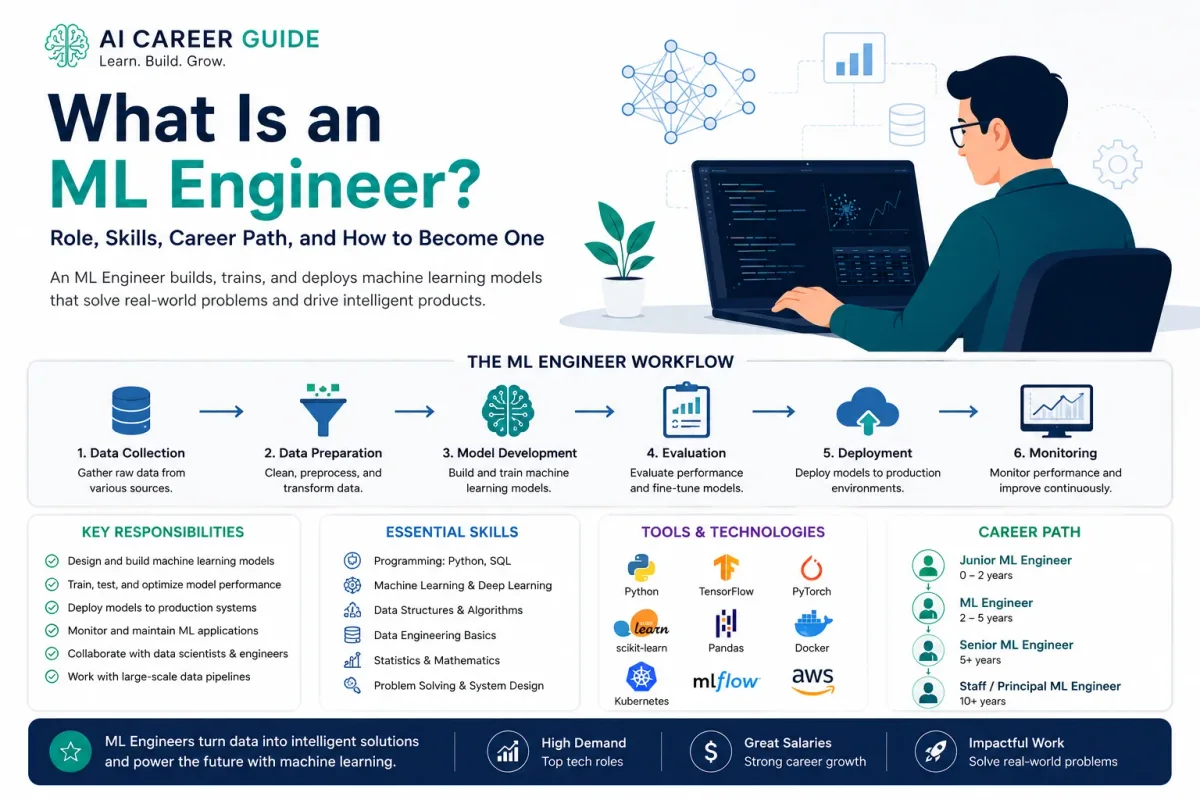
Machine learning is often introduced as a modeling problem: give a model data, train it, measure its performance, and improve it.
That is only part of the job.
A machine learning engineer (ML engineer) builds the software systems that turn data and machine learning models into reliable products. The role sits between machine learning, data, and software engineering.
A typical ML workflow looks like this:
Data
  ↓
Preparation
  ↓
Features / Representations
  ↓
Model
  ↓
Evaluation
  ↓
Serving
  ↓
Monitoring
  ↓
Improvement
The model is one component. The engineering around it is what makes the system useful.
For the related AI role, see What Is an AI Engineer?. For the broader skill stack, see AI Engineer Skills.
What Does an ML Engineer Do?
The exact job varies by company, but common responsibilities include:
- preparing and validating datasets
- building data and feature pipelines
- training and tuning models
- designing evaluation workflows
- deploying models
- building prediction APIs
- monitoring model and system performance
- investigating failures and data drift
- retraining or updating models
- collaborating with software, data, and product teams
An ML engineer may work on recommendation systems, fraud detection, forecasting, search and ranking, computer vision, NLP, or machine learning infrastructure.
A production workflow is closer to:
Business Problem
      ↓
Data
      ↓
Baseline
      ↓
Model
      ↓
Evaluation
      ↓
Deployment
      ↓
Monitoring
      ↓
Iteration
That is why ML engineering is different from simply training models in a notebook.
ML Engineer vs AI Engineer vs Software Engineer
These roles overlap, and companies do not always use the titles consistently.
| Role | Typical center of gravity |
|---|---|
| ML Engineer | Data, model training, evaluation, serving, monitoring |
| AI Engineer | AI applications, LLMs, retrieval, tools, product integration |
| Software Engineer | General software systems, APIs, infrastructure, product engineering |
A strong ML engineer still needs software engineering.
A strong AI engineer should understand machine learning.
A software engineer working on an ML platform may perform responsibilities from both areas.
For comparison, see the AI Engineer career path and Software Engineer career path.
Skills an ML Engineer Needs
A practical skill stack is:
Programming
    ↓
DSA + Problem Solving
    ↓
Math + Statistics
    ↓
Machine Learning
    ↓
Deep Learning
    ↓
Data Engineering
    ↓
Model Serving
    ↓
MLOps
    ↓
System Design
You do not need research-level depth in every layer. Your depth should match the kind of ML engineering role you want.
1. Python and Programming
Python is one of the most useful languages for machine learning.
Learn:
- functions and modules
- object-oriented programming
- exceptions
- packages and environments
- typing
- testing
- debugging
- logging
The goal is to build maintainable software, not just run experiments.
C++ can also be valuable for DSA, performance-sensitive work, and systems fundamentals.
2. Data Structures and Algorithms
Learn arrays, hash maps, sets, trees, heaps, graphs, queues, sorting, searching, recursion, and dynamic programming.
You do not need to become a competitive-programming specialist, but you should understand complexity and choose data structures deliberately.
Use DSA Mastery and the Interviews roadmap for structured preparation.
3. Mathematics and Statistics
Focus on:
Linear algebra: vectors, matrices, dot products, matrix multiplication, norms.
Probability: conditional probability, distributions, expectation, variance, Bayes’ theorem.
Statistics: sampling, correlation, regression, confidence intervals, hypothesis testing.
Calculus: derivatives, gradients, chain rule, optimization.
The objective is understanding rather than memorizing formulas.
4. Machine Learning
Understand:
- supervised and unsupervised learning
- regression
- classification
- clustering
- dimensionality reduction
- ensemble methods
- overfitting
- underfitting
- regularization
- feature engineering
- cross-validation
- data leakage
- class imbalance
- model selection
- error analysis
Start with the Machine Learning guide.
5. Model Evaluation
A model is only useful if its performance matches the real problem.
For classification, understand precision, recall, F1, ROC-AUC, PR-AUC, and confusion matrices.
For regression, understand MAE, MSE, RMSE, and R².
More importantly, ask:
Which mistakes are expensive for this product?
The best metric is determined by the problem, not by habit.
6. Data Quality and Feature Engineering
Learn how to identify:
- missing values
- inconsistent labels
- duplicates
- outliers
- leakage
- distribution shifts
- training-serving skew
A robust pipeline looks like:
Raw Data
   ↓
Validation
   ↓
Cleaning
   ↓
Transformation
   ↓
Features
   ↓
Training
A sophisticated model cannot compensate for unreliable data.
7. Deep Learning
Learn tensors, layers, activation functions, loss functions, backpropagation, optimization, regularization, and training loops.
Then understand CNNs, RNNs, LSTMs, attention, and transformers.
For practical work, become comfortable with PyTorch.
See the Deep Learning guide.
8. Data Engineering
Real ML systems depend on dependable data pipelines.
Understand:
- ingestion
- ETL/ELT
- batch processing
- data validation
- storage
- databases
- feature pipelines
- distributed processing concepts
You do not need to become a full data engineer, but you should understand how data reaches the model and how that pipeline can fail.
9. Model Serving and APIs
A trained model must become a usable service.
Client
 ↓
API
 ↓
Validation
 ↓
Preprocessing
 ↓
Model
 ↓
Prediction
Learn REST APIs, serialization, request validation, authentication, error handling, health checks, batching, and asynchronous processing.
FastAPI is a practical choice for Python-based ML services.
10. MLOps
MLOps connects machine learning development with reliable software delivery.
Learn:
- experiment tracking
- model versioning
- data versioning
- CI/CD
- deployment
- monitoring
- rollback
- automated evaluation
A useful lifecycle is:
Experiment
 ↓
Evaluate
 ↓
Register
 ↓
Deploy
 ↓
Monitor
 ↓
Retrain
11. Model Monitoring
A model can work perfectly on launch and degrade later.
Monitor:
- input distributions
- prediction distributions
- data drift
- concept drift
- latency
- error rates
- throughput
- business metrics
The goal is to detect when the system no longer behaves as expected.
12. System Design
Once you move beyond small projects, you need to reason about scale and reliability.
For a recommendation system:
User Events
    ↓
Data Pipeline
    ↓
Feature Processing
    ↓
Training
    ↓
Model Registry
    ↓
Serving
    ↓
Recommendations
    ↓
Feedback
    └──────────→ Training
Ask:
- What happens at high traffic?
- How are models updated?
- What can be cached?
- What happens when the model is unavailable?
- How is quality monitored?
- How is stale data handled?
That is ML system design.
What Do ML Engineers Build?
Common examples include:
Recommendation Systems
Personalize products, jobs, articles, videos, or other content.
Fraud Detection
Predict suspicious activity while controlling false positives.
Forecasting
Predict demand, sales, traffic, or other future values.
Search and Ranking
Rank results according to relevance.
Computer Vision
Classify images, detect objects, or inspect products.
Natural Language Processing
Classify, extract, summarize, or analyze text.
ML Platforms
Build tooling and infrastructure that help other teams train, deploy, and monitor models.
The Projects hub contains practical directions for building portfolio evidence.
How to Become an ML Engineer
A practical progression is:
Programming
   ↓
DSA + Problem Solving
   ↓
Git + Linux + SQL
   ↓
Math + Statistics
   ↓
Machine Learning
   ↓
Projects
   ↓
Deep Learning
   ↓
APIs + Deployment
   ↓
MLOps
   ↓
System Design
   ↓
Internships
   ↓
Interviews
Do not wait until you finish the whole sequence before building.
Build while learning.
The ML Engineer career roadmap gives you a structured progression.
ML Engineer Project Progression
Start with small, complete projects.
Beginner
- house price prediction
- spam classification
- customer churn prediction
Your House Price Prediction project is a good example of an introductory end-to-end ML project.
Intermediate
Move toward:
- recommendation systems
- fraud detection
- forecasting
- NLP classification
Advanced
Add:
- data pipelines
- model APIs
- deployment
- monitoring
- automated evaluation
The objective is to move from modeling to systems engineering.
ML Engineer vs AI Engineer: Which Path Is Better?
Neither is universally better.
ML engineering may suit you more if you enjoy:
- data
- model training
- experimentation
- predictive modeling
- optimization
- model performance
AI engineering may suit you more if you prefer:
- LLM applications
- RAG
- AI tools and agents
- backend integration
- product development
- end-to-end AI systems
The foundations overlap heavily, so you do not need to make a permanent decision early.
How to Become Job-Ready
A useful baseline is being able to:
- write Python confidently
- use Git and Linux
- work with SQL
- understand core ML algorithms
- evaluate models correctly
- build a deep learning project
- build a prediction API
- deploy a model
- understand monitoring
- explain architecture and trade-offs
Your portfolio should demonstrate:
Problem
 ↓
Data
 ↓
Model
 ↓
Evaluation
 ↓
Deployment
 ↓
Monitoring
That is stronger evidence than a resume full of tools.
For career preparation, use the Internships roadmap and Interviews roadmap.
Common Mistakes
Focusing only on models
Training is one stage of the lifecycle.
Ignoring data
Poor data can dominate model quality.
Skipping software engineering
Production ML needs APIs, testing, deployment, and monitoring.
Chasing every framework
Tools change quickly. Fundamentals last longer.
Building only notebook projects
A notebook shows experimentation. A deployed system shows engineering.
Measuring only accuracy
The right metric depends on the real objective.
Ignoring drift
Production data changes. Models need monitoring and maintenance.
What Makes a Strong ML Engineer?
A strong ML engineer can move through the full lifecycle:
Problem
 ↓
Data
 ↓
Model
 ↓
Evaluation
 ↓
Deployment
 ↓
Monitoring
 ↓
Improvement
They can answer:
Why this model?
What does the metric actually mean?
What happens when the data distribution changes?
How would you serve the model at scale?
How would you detect model degradation?
How would you retrain safely?
That is the difference between running a training script and engineering an ML system.
Final Thoughts
Machine learning engineering is the discipline of turning machine learning into dependable software.
You need enough mathematics to understand the methods, enough machine learning knowledge to choose and evaluate models, enough software engineering to build the application around them, and enough MLOps to keep the system healthy after deployment.
Build in layers:
Python
   ↓
Software Engineering
   ↓
Math + Statistics
   ↓
Machine Learning
   ↓
Projects
   ↓
Deep Learning
   ↓
Deployment
   ↓
MLOps
   ↓
System Design
Build while learning.
Measure what you build.
Understand what fails.
Fix it.
Then build something harder.
That is how you move from learning machine learning to becoming an ML engineer.
Your Next Step
Start with the ML Engineer roadmap.
Then strengthen the fundamentals with Machine Learning, Deep Learning, and practical work through the Projects hub.
For career preparation, continue with Internships and Interviews.
Learn → Build → Evaluate → Deploy → Monitor → Improve.
Continue the path
Keep building from here
ML Engineer Skills: The Complete Skill Set You Need in 2026
Learn the essential ML engineer skills for 2026, from Python, mathematics, and machine learning to software engineering, deployment, MLOps, and communication.
How to Become an ML Engineer: A Practical Roadmap for 2026
A practical ML engineer roadmap covering Python, math, machine learning, software engineering, projects, deployment, and career preparation.
AI Engineer Roadmap
A practical AI engineer roadmap covering software engineering, math, ML, deep learning, LLMs, deployment, evaluation, and career preparation.
AI Research Assistant
Build an LLM research assistant with document search, evidence retrieval, grounded summaries, source comparison, and citations.
Hands-On Machine Learning
A practical reference for machine learning with Python, scikit-learn, deep learning, and modern ML workflows.
Practical Deep Learning for Coders
A practical course centered on building and training deep learning systems with a strong implementation focus.