
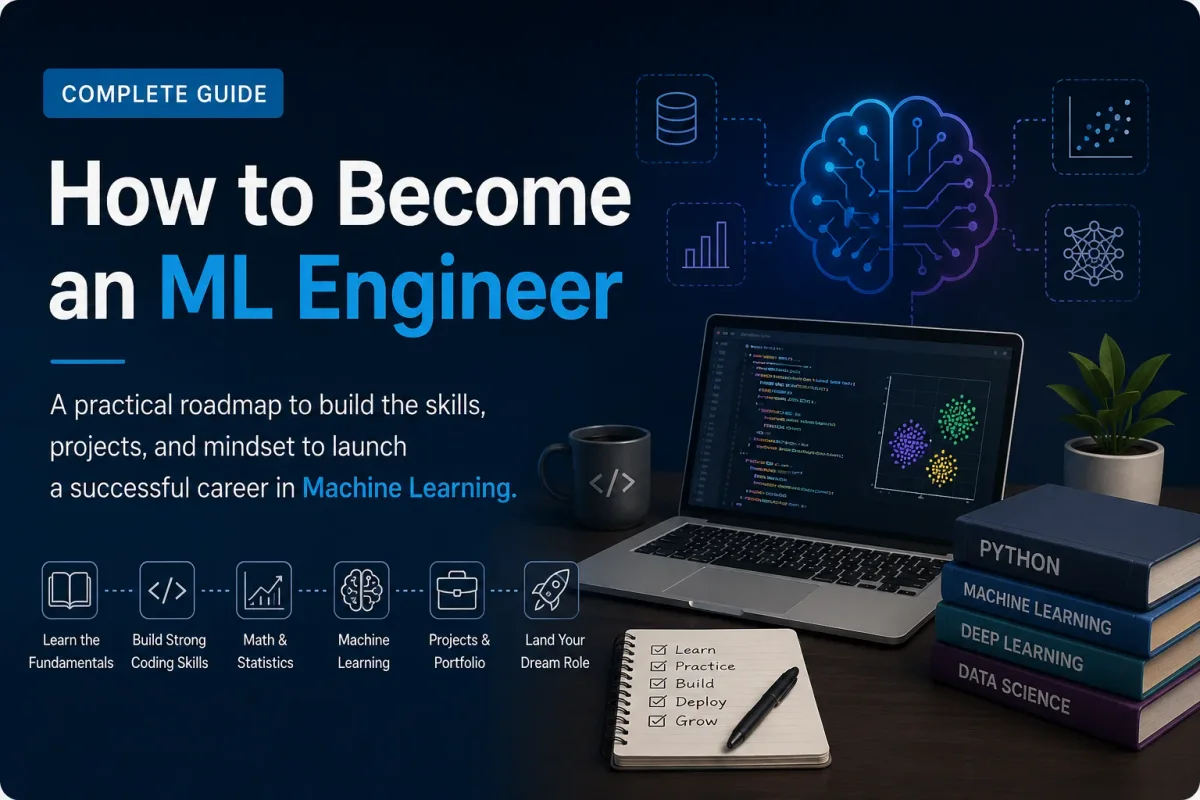
Machine learning engineering is not just about training models. A good ML engineer can understand a problem, work with data, build reliable models, write production-quality software, deploy systems, monitor them, and improve them over time.
That is what makes the role different from simply knowing how to use a machine learning library.
This guide explains how to become an ML engineer from the ground up. For a definition of the role itself, start with What Is an ML Engineer?. Instead of focusing on collecting certificates, the roadmap focuses on the skills that compound over time: programming, mathematics, machine learning fundamentals, software engineering, system thinking, and real projects.
The goal: become an engineer who can take a machine learning problem from an idea to a working production system.
What Does an ML Engineer Actually Do?
A machine learning engineer sits at the intersection of software engineering, data, and machine learning.
Depending on the company and product, an ML engineer may work on tasks such as:
- Preparing and validating datasets
- Designing features and data pipelines
- Training and evaluating machine learning models
- Improving model performance and reliability
- Building inference APIs and services
- Deploying models to cloud or on-premise infrastructure
- Monitoring predictions, latency, and failures
- Automating model training and deployment workflows
- Collaborating with data scientists, backend engineers, product teams, and researchers
A useful way to think about the role is:
Data → Model → Software → Deployment → Monitoring → Improvement
Learning only the Model part is not enough for an engineering-focused career.
ML Engineer vs Data Scientist vs AI Engineer
These roles overlap, but their primary responsibilities are different.
| Role | Main Focus |
|---|---|
| Data Scientist | Analysis, experimentation, statistics, and business insights |
| ML Engineer | Production machine learning systems and model integration |
| AI Engineer | Building applications and products powered by modern AI models |
| ML Researcher | Developing new algorithms, architectures, or scientific methods |
| Software Engineer | Designing and building reliable software systems |
In real companies, the boundaries are often blurred. A strong ML engineer still needs software engineering and data skills, while an AI engineer may use many of the same machine learning foundations.
The Machine Learning Engineer Roadmap
A practical roadmap looks like this:
Programming → Mathematics → Data → Machine Learning → Deep Learning → Software Engineering → Deployment → MLOps → Projects → Interview Preparation
You do not have to master every topic before moving forward. Build a foundation, apply it through projects, then return to deepen your understanding.
Step 1: Learn Python Properly
Python is one of the most important programming languages for machine learning because of its mature ecosystem for data, scientific computing, and AI.
Do not learn Python only as a collection of syntax rules. Learn how to write maintainable programs.
What to learn
Focus on:
- Variables, data types, conditions, and loops
- Functions and modules
- Lists, tuples, sets, and dictionaries
- Object-oriented programming
- Exception handling
- File handling
- Iterators and generators
- Virtual environments and package management
- Type hints
- Testing basics
- Debugging
- Git and GitHub
You should be comfortable taking a small problem and turning it into a clean Python program without copying a tutorial line by line.
Libraries to learn
Start with the core data stack:
- NumPy
- pandas
- Matplotlib
- scikit-learn
Later, depending on your goals, move into tools such as PyTorch, FastAPI, Docker, and cloud platforms.
A good checkpoint
Before going deep into machine learning, you should be able to build a small Python project from an empty folder, organize its files, install dependencies, use Git, and explain your own code. A useful companion is the AI Engineer Skills guide.
Step 2: Build the Mathematics Foundation
You do not need to become a pure mathematician to become an ML engineer. You do need enough mathematics to understand what your models are doing.
The most useful areas are:
Linear Algebra
Learn:
- Vectors
- Matrices
- Matrix multiplication
- Dot products
- Linear transformations
- Eigenvalues and eigenvectors
Linear algebra appears throughout machine learning, from feature representations to neural networks.
Calculus
Focus on:
- Functions
- Derivatives
- Partial derivatives
- Gradients
- Chain rule
- Optimization intuition
The key goal is understanding how a model learns by changing its parameters to reduce an objective function.
Probability and Statistics
Learn:
- Mean, variance, and standard deviation
- Probability distributions
- Conditional probability
- Bayes’ theorem
- Expected value
- Sampling
- Correlation and covariance
- Hypothesis testing basics
These concepts help with uncertainty, evaluation, experimentation, and data analysis.
Optimization
Understand the intuition behind:
- Loss functions
- Gradient descent
- Learning rates
- Local and global minima
- Regularization
You should be able to explain why an algorithm works, not just call a library function.
Step 3: Master Data Handling
Machine learning starts with data, and poor data can destroy an otherwise sophisticated model.
Learn how to:
- Load datasets from different sources
- Inspect data quality
- Handle missing values
- Detect outliers
- Encode categorical variables
- Scale numerical features when appropriate
- Split data correctly
- Prevent data leakage
- Build reproducible preprocessing pipelines
- Perform exploratory data analysis
A useful principle is:
Garbage in, garbage out.
Spend enough time understanding the dataset before training a model.
What you should practice
Take a real dataset and answer:
- What does each feature represent?
- What is the target?
- Which values are missing?
- Which features may be problematic?
- Is the target imbalanced?
- What information would accidentally leak into the training process?
- What preprocessing is justified?
These questions are closer to real ML engineering than simply running .fit().
Step 4: Learn Classical Machine Learning
Before jumping directly into large language models or advanced deep learning, understand classical machine learning.
Start with the concepts behind:
Supervised Learning
- Linear regression
- Logistic regression
- Decision trees
- Random forests
- Gradient boosting
- k-nearest neighbors
- Support vector machines
Unsupervised Learning
- K-means clustering
- Hierarchical clustering
- Principal component analysis
Core concepts
You should understand:
- Training, validation, and test sets
- Overfitting and underfitting
- Bias and variance
- Feature engineering
- Cross-validation
- Hyperparameter tuning
- Classification vs regression
- Model selection
- Data leakage
Do not measure progress by the number of algorithms you know. Measure it by whether you can choose an appropriate approach and explain why.
Step 5: Learn Model Evaluation
A model is useful only when you know whether it works.
For classification, learn metrics such as:
- Accuracy
- Precision
- Recall
- F1 score
- ROC-AUC
- Confusion matrix
For regression, learn:
- Mean absolute error
- Mean squared error
- Root mean squared error
- R²
More importantly, understand when each metric is appropriate.
For example, accuracy can be misleading when one class dominates the dataset. In that situation, precision, recall, F1 score, or other problem-specific metrics may provide a more useful view of performance.
Step 6: Learn Deep Learning
Once classical machine learning feels comfortable, learn the fundamentals of deep learning.
A practical sequence is:
- Neural networks
- Forward and backward propagation
- Activation functions
- Loss functions
- Optimizers
- Regularization
- Batch normalization
- Convolutional neural networks
- Sequence models
- Transformers
Choose PyTorch or another major deep learning framework and build models yourself.
You should understand what happens during a training step instead of treating the framework as a black box.
Do not rush into every new AI trend
The field changes quickly. Frameworks, model architectures, and tools will continue to evolve.
Fundamentals are more durable:
optimization + representation + evaluation + data + software engineering
Build those first.
Step 7: Become a Strong Software Engineer
This is one of the biggest differences between a beginner who can train models and an ML engineer who can build production systems.
You should learn:
- Data structures and algorithms
- Object-oriented design
- Clean code
- API design
- Databases
- SQL
- Networking basics
- Operating systems fundamentals
- Concurrency basics
- Testing
- Logging
- Git and GitHub
- Software architecture
You do not need to become a backend specialist before learning ML. You do need enough software engineering ability to build reliable systems around your models.
A machine learning model is usually one component inside a larger application.
Step 8: Learn to Deploy Machine Learning Models
Training a model locally is only part of the job.
Learn how to expose a model through an API and make it usable by another application.
A simple progression is:
Notebook → Python application → REST API → Docker container → Cloud deployment → Monitoring
Useful technologies include:
- FastAPI
- Docker
- GitHub Actions
- Linux
- Cloud platforms
- Object storage
- Databases
- Monitoring and logging tools
You do not need to learn every cloud service. Learn the underlying concepts first and then implement them with one platform.
Step 9: Learn MLOps Fundamentals
MLOps is the engineering discipline around reliably developing, deploying, and maintaining machine learning systems.
At a practical level, understand:
- Reproducible training
- Data and model versioning
- Experiment tracking
- Automated testing
- Continuous integration and deployment
- Model packaging
- Model serving
- Monitoring
- Retraining workflows
- Model rollback
A production model can become less useful even when its code never changes because the real-world data changes.
That is why monitoring and maintenance matter.
Step 10: Build Real ML Projects
Projects are where the roadmap becomes real. You can also use the site’s projects library to choose a project that matches your current level.
Do not build ten copied projects that all follow the same tutorial.
Build fewer projects with increasing engineering complexity.
Project 1: End-to-End Tabular ML
Build a project such as:
- House price prediction
- Customer churn prediction
- Loan default prediction
- Sales forecasting
Include data cleaning, exploratory analysis, model training, evaluation, and a clear README.
Project 2: ML API
Take one model and turn it into a service.
Include:
- FastAPI endpoint
- Input validation
- Model loading
- Error handling
- Documentation
- Tests
Project 3: Production-Style ML Application
Build something closer to a real product. The goal is to move beyond a notebook and toward the kind of system described in the ML Engineer career roadmap.
For example:
- Fraud detection system
- Recommendation engine
- Document classification service
- Demand forecasting platform
- Image classification application
Include a frontend or client, backend API, model service, database, logging, Docker, and deployment.
Project 4: Deep Learning System
Choose one meaningful problem and implement it using a deep learning framework.
The project should demonstrate that you understand the entire pipeline, not just model training.
Step 11: Build a Portfolio That Shows Engineering Ability
Your GitHub should tell a clear story about what you can build.
A strong ML project repository should contain:
- A clear problem statement
- Dataset information
- Architecture or workflow diagram
- Installation instructions
- Reproducible setup
- Training process
- Evaluation results
- Example predictions
- API documentation when relevant
- Tests
- Deployment instructions
- Limitations and future improvements
Do not write a README that says only:
“This project predicts house prices using machine learning.”
Explain the engineering decisions.
For example:
“The pipeline separates preprocessing from model training to prevent inconsistent transformations between training and inference.”
That demonstrates understanding.
Step 12: Learn SQL and Databases
ML engineers work with data systems constantly, so SQL is not optional knowledge.
Learn:
- SELECT and filtering
- JOINs
- Aggregation
- GROUP BY
- Subqueries
- Window functions
- Indexes
- Transactions
- Basic database design
Start with a relational database such as PostgreSQL or another widely used SQL database.
The objective is not to become a database administrator. The objective is to confidently work with real application data.
Step 13: Learn Linux, Git, and Developer Tooling
Production ML work involves much more than notebooks.
You should be comfortable with:
- Linux command line
- Shell basics
- Processes and files
- Environment variables
- Git branching
- Pull requests
- Debugging
- Package management
- Containers
The command line should feel normal rather than intimidating.
Step 14: Prepare for ML Engineer Interviews
Once your technical foundation is solid, prepare specifically for interviews. The AI Engineer interview questions guide is useful for building a structured review routine.
Expect combinations of:
Coding
Practice data structures and algorithms using a language you can code confidently in.
Focus on:
- Arrays and strings
- Hashing
- Linked lists
- Stacks and queues
- Trees
- Graphs
- Binary search
- Recursion
- Dynamic programming
- Sorting and searching
Machine Learning
Be ready to explain:
- How common algorithms work
- Bias and variance
- Regularization
- Feature engineering
- Model evaluation
- Cross-validation
- Data leakage
- Class imbalance
- Hyperparameter tuning
ML System Design
Learn to reason about:
- Data pipelines
- Feature stores
- Training pipelines
- Batch vs real-time inference
- Scaling inference
- Model versioning
- Monitoring
- Failure handling
- Retraining
The best interview preparation is usually real engineering practice combined with deliberate review.
A Realistic ML Engineer Learning Path
Here is a practical sequence you can follow:
| Stage | Main Focus | Typical Output |
|---|---|---|
| 1 | Python | Clean Python projects |
| 2 | Mathematics | Understanding of ML foundations |
| 3 | NumPy + pandas | Data analysis projects |
| 4 | Classical ML | End-to-end ML project |
| 5 | Deep Learning | Neural network project |
| 6 | Software Engineering | APIs, testing, Git |
| 7 | Deployment | Containerized ML service |
| 8 | MLOps | Reproducible ML workflow |
| 9 | System Design | Production architecture |
| 10 | Career Preparation | Portfolio + interviews |
The stages overlap. Do not treat this as a rigid checklist.
How Long Does It Take to Become an ML Engineer?
There is no universal timeline.
A motivated beginner can build a useful foundation within months, but becoming genuinely strong at ML engineering takes much longer because the skill set spans several disciplines.
A better question is:
What can you build independently now that you could not build three months ago?
Use projects and measurable capabilities as your progress tracker instead of counting certificates or tutorial hours.
Common Mistakes Beginners Make
1. Jumping directly into advanced AI
Starting with large models without understanding programming, data, evaluation, and basic ML often creates shallow knowledge.
2. Collecting courses instead of building
Watching another course feels productive, but building a system forces you to solve problems that tutorials hide.
3. Ignoring software engineering
A model that works inside a notebook is not necessarily a production-ready system.
4. Learning every framework
You do not need ten ML libraries. Learn the concepts and become excellent with a small set of tools.
5. Copying portfolio projects
A copied project demonstrates that you can follow instructions. An original project demonstrates that you can make engineering decisions.
6. Chasing every AI trend
New tools appear constantly. Strong fundamentals remain useful across technology cycles.
7. Ignoring communication
Engineers need to explain technical trade-offs clearly to teammates and stakeholders.
What Should You Learn First?
For someone starting from scratch, a strong order is. The site’s AI Engineer roadmap is another useful reference for the broader AI engineering path:
Python → Git → NumPy/pandas → Mathematics → Classical ML → Projects → SQL → Software Engineering → Deep Learning → APIs → Docker → Cloud → MLOps → System Design
You can adjust the order based on your background, but avoid skipping the foundations just because an advanced topic looks more exciting.
Your Goal Should Be to Build, Not Just Learn
The fastest way to expose gaps in your knowledge is to build something.
When you try to deploy a model, you suddenly discover questions about APIs, serialization, dependencies, validation, latency, logging, security, and infrastructure.
Those problems are valuable. They turn abstract knowledge into engineering ability.
A useful cycle is:
Learn → Build → Break → Debug → Understand → Improve → Repeat
That cycle is more valuable than endlessly collecting courses.
Final Thoughts
Becoming an ML engineer is a long-term engineering journey, not a single course or certification.
You need a combination of:
- Strong programming fundamentals
- Practical mathematics
- Machine learning knowledge
- Data skills
- Software engineering
- Deployment knowledge
- MLOps fundamentals
- System design
- Real project experience
Do not try to master everything at once.
Start with Python. Learn the mathematics behind the algorithms. Build classical ML projects. Strengthen your software engineering skills. Deploy your models. Then progress into deep learning, MLOps, and larger systems.
The target is simple:
Become someone who can take a machine learning problem from raw data to a reliable working product.
That is the core of machine learning engineering.
Frequently Asked Questions
Is a degree required to become an ML engineer?
A degree can help, especially for internships and early-career opportunities, but practical ability matters heavily. Strong projects, programming skills, ML knowledge, and engineering experience can make your profile much stronger.
Do I need advanced mathematics to become an ML engineer?
You need a solid working understanding of linear algebra, calculus, probability, statistics, and optimization. You do not need to prove advanced theorems to work effectively as an ML engineer.
Should I learn data science before machine learning engineering?
You need data skills, but you do not need to become a full-time data scientist first. Learn enough statistics, SQL, data analysis, and data preprocessing to work confidently with real ML datasets.
Should I learn deep learning before classical machine learning?
For most beginners, classical machine learning is the better starting point. It teaches core ideas such as features, loss functions, evaluation, overfitting, and model selection before adding the additional complexity of deep neural networks.
Is Python enough for an ML engineer?
Python is extremely useful, but an ML engineer also benefits from SQL, Git, Linux, APIs, databases, Docker, cloud concepts, and strong software engineering fundamentals. Depending on the role, knowledge of languages such as C++ or Java may also be useful.
How many ML projects should I build?
There is no magic number. A small number of substantial projects is usually more valuable than a large collection of shallow tutorial projects. Aim for projects that demonstrate progressively stronger technical and engineering skills.
Recommended Next Steps
Start with one small end-to-end machine learning project and use it to identify your knowledge gaps. The Machine Learning Guide and Hands-on Machine Learning resource can support the learning phase.
Then expand it step by step:
Dataset → preprocessing → model → evaluation → API → Docker → deployment → monitoring
That single progression can teach you more about ML engineering than dozens of disconnected tutorials.
Related Guides
- What Is an ML Engineer?
- Machine Learning Guide
- AI Engineer Skills
- ML Engineer Career Roadmap
- AI Engineer Career Roadmap
- Machine Learning
- Deep Learning
- House Price Prediction Project
- Data Structures & Algorithms Roadmap
- Interview Preparation Roadmap
- Hands-on Machine Learning
- Python Data Science Handbook
Continue the path
Keep building from here
ML Engineer Skills: The Complete Skill Set You Need in 2026
Learn the essential ML engineer skills for 2026, from Python, mathematics, and machine learning to software engineering, deployment, MLOps, and communication.
What Is an ML Engineer? Role, Skills, and Career Path
Learn what ML engineers do, the skills they need, how the role differs from AI and software engineering, and how to start.
AI Engineer Roadmap
A practical AI engineer roadmap covering software engineering, math, ML, deep learning, LLMs, deployment, evaluation, and career preparation.
AI Research Assistant
Build an LLM research assistant with document search, evidence retrieval, grounded summaries, source comparison, and citations.
Hands-On Machine Learning
A practical reference for machine learning with Python, scikit-learn, deep learning, and modern ML workflows.
UCI Machine Learning Repository
A collection of datasets useful for learning and experimenting with machine learning workflows.