
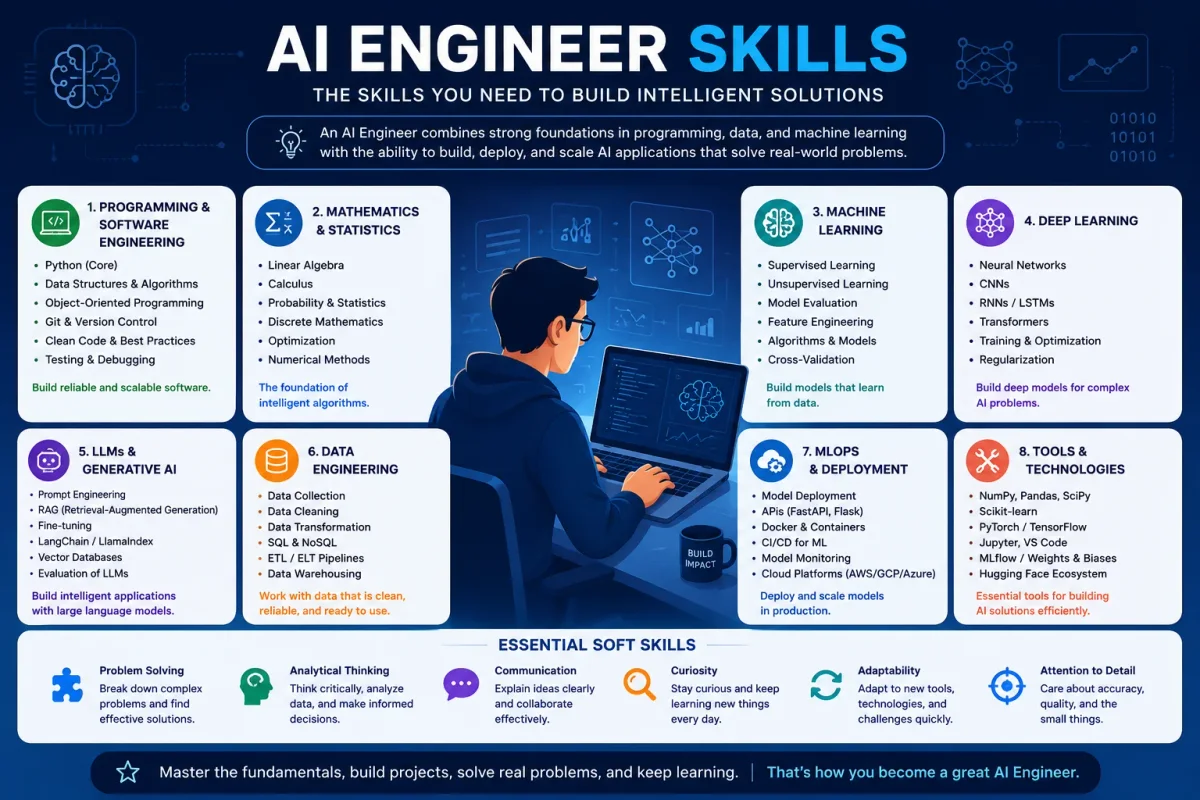
The AI engineering field looks crowded from the outside.
There are new models, frameworks, vector databases, agent platforms, cloud services, courses, and tools appearing all the time. It is easy to assume you need to learn everything before you can call yourself an AI engineer.
You don’t.
The more useful question is:
What capabilities allow an engineer to build, evaluate, deploy, and maintain useful AI systems?
That leads to a much smaller and more practical skill set.
An AI engineer needs strong software engineering fundamentals, a working understanding of machine learning and deep learning, practical knowledge of modern AI systems such as LLMs and retrieval, and enough production engineering to turn experiments into dependable software.
Think of the skill stack like this:
Problem Solving
      ↓
Programming
      ↓
Software Engineering
      ↓
Math + Machine Learning
      ↓
Deep Learning
      ↓
LLMs + Retrieval
      ↓
Evaluation
      ↓
Deployment + Operations
      ↓
System Design
You do not need equal depth across every layer.
You need a strong foundation at the bottom and enough depth at the top to build systems independently.
The First Skill: Problem Solving
Before discussing Python, PyTorch, or LLMs, there is a more fundamental skill: being able to solve problems.
AI engineering is full of decisions that don’t come with a ready-made answer.
You may need to decide:
- whether a problem actually needs AI
- whether classical machine learning is sufficient
- whether an LLM is appropriate
- whether retrieval is necessary
- how much data is enough
- how to evaluate the result
- what to do when the model fails
These aren’t syntax questions.
They are reasoning questions.
A useful engineering loop is:
Understand the problem
        ↓
Define constraints
        ↓
Break the problem down
        ↓
Choose an approach
        ↓
Build a baseline
        ↓
Measure
        ↓
Find weaknesses
        ↓
Improve
This skill compounds across everything else you learn.
1. Python
Python is one of the most important practical skills for AI engineering because it connects data work, machine learning, deep learning, APIs, automation, and experimentation.
You should be comfortable writing real Python programs, not only notebooks.
Core Python
Learn:
- variables and data types
- conditionals and loops
- functions
- modules and packages
- exceptions
- file handling
- comprehensions
- iterators
- generators
- decorators
- context managers
- object-oriented programming
- type hints
Then move into practical development:
- virtual environments
- package management
- testing
- logging
- debugging
- configuration
- command-line applications
The goal is simple:
You should be able to open an empty editor and build a small Python application from scratch.
For AI work, Python also becomes the language through which you connect models, databases, APIs, data pipelines, and services.
2. Data Structures and Algorithms
AI engineers still need strong programming fundamentals.
You should know:
- arrays
- strings
- hash maps
- sets
- linked lists
- stacks
- queues
- trees
- heaps
- graphs
- tries
You should also understand:
- binary search
- two pointers
- sliding window
- recursion
- backtracking
- greedy algorithms
- dynamic programming
- graph traversal
- shortest paths
There are two reasons this matters.
First, it improves problem-solving ability.
Second, software and AI systems still depend on efficient data processing.
An AI application might need to search millions of records, maintain a cache, process an event stream, or handle a large number of requests. The model does not remove the need for good algorithms.
For dedicated interview preparation, use the Interviews roadmap.
3. Software Engineering
This is probably the most valuable skill that people underestimate when entering AI.
A model is not a product.
You still need to build:
API
 ↓
Validation
 ↓
Business Logic
 ↓
AI Workflow
 ↓
Database
 ↓
Response
Learn:
- Git and GitHub
- Linux
- HTTP
- REST APIs
- JSON
- SQL
- databases
- authentication
- authorization
- testing
- logging
- debugging
- error handling
- environment variables
- Docker
- CI/CD
You should know how to organize a codebase, separate responsibilities, write tests, and handle failures.
An AI engineer who can only work inside notebooks will eventually hit a ceiling.
The Software Engineer roadmap covers this foundation in more depth.
4. SQL and Databases
Modern AI systems work with far more than model weights.
They often need:
- user accounts
- documents
- metadata
- application state
- feedback
- logs
- conversations
- permissions
- evaluation results
That means databases matter.
Start with SQL.
Learn:
- SELECT
- filtering
- joins
- grouping
- aggregation
- subqueries
- CTEs
- window functions
- indexes
- transactions
Then understand:
- primary keys
- foreign keys
- constraints
- normalization
- isolation
- consistency
PostgreSQL is a useful system to become comfortable with because it can support both ordinary application data and vector-oriented AI workloads when configured appropriately.
5. Linux and Developer Tools
You do not need to become a Linux administrator.
But you should be comfortable working from the command line.
Learn:
- filesystems
- permissions
- processes
- services
- environment variables
- SSH
- logs
- package management
- basic networking commands
You should be comfortable with tools such as:
git
curl
grep
find
ps
top
ssh
Also get used to reading documentation.
Strong engineers spend a lot of time figuring things out from documentation rather than waiting for a tutorial.
6. Mathematics
The amount of math you need depends on the role.
An AI application engineer does not need the same mathematical depth as someone doing model research.
Still, a solid foundation is valuable.
Linear Algebra
Understand:
- vectors
- matrices
- dot products
- matrix multiplication
- norms
- transformations
- eigenvalues and eigenvectors
These ideas appear in:
- embeddings
- neural networks
- dimensionality reduction
- attention
Probability and Statistics
Understand:
- probability distributions
- conditional probability
- expectation
- variance
- correlation
- sampling
- confidence intervals
- hypothesis testing
Calculus and Optimization
Understand:
- derivatives
- partial derivatives
- gradients
- chain rule
- gradient descent
- optimization
You do not need to memorize hundreds of equations.
You need to understand what the mathematics is doing.
7. Machine Learning
You should understand classical machine learning even if your main interest is LLMs.
Learn:
- linear regression
- logistic regression
- decision trees
- random forests
- gradient boosting
- nearest neighbors
- clustering
- PCA
More importantly, understand:
- training
- validation
- test sets
- cross-validation
- feature engineering
- overfitting
- underfitting
- regularization
- data leakage
- class imbalance
- model selection
A good AI engineer should recognize when a simple ML model is a better engineering solution than a large generative model.
See Machine Learning and the ML Engineer roadmap.
8. Model Evaluation
Knowing how to evaluate a model is a core engineering skill.
For classical machine learning, understand metrics such as:
Classification
- accuracy
- precision
- recall
- F1
- ROC-AUC
- confusion matrix
Regression
- MAE
- MSE
- RMSE
- R²
But don’t stop at the formula.
Ask:
What does success actually mean for this application?
A metric that is useful for one problem may be misleading for another.
Evaluation is the bridge between “the model runs” and “the system works.”
9. Deep Learning
Once your machine learning foundation is solid, develop a working understanding of neural networks.
Learn:
- tensors
- layers
- parameters
- activation functions
- loss functions
- forward passes
- backpropagation
- gradients
- optimizers
- regularization
- training loops
Then understand:
- CNNs
- RNNs
- LSTMs
- attention
- transformers
For practical work, learn PyTorch well enough to:
- create models
- load data
- write training loops
- evaluate experiments
- save and load models
- debug training problems
See the Deep Learning guide.
10. Transformers and LLMs
Modern AI engineering increasingly involves foundation models.
You should understand:
- tokenization
- embeddings
- context windows
- attention
- self-attention
- transformer blocks
- language modeling
- inference
- sampling
Then learn practical LLM engineering:
- model APIs
- structured outputs
- streaming
- prompt design
- tool calling
- model selection
- latency
- token usage
- cost
Don’t build your knowledge around one provider.
Providers change.
The underlying concepts are more durable.
See the LLMs guide.
11. Prompt Engineering
Prompting matters, but it should not become your entire AI skill set.
Learn how to work with:
- system instructions
- structured outputs
- few-shot examples
- context construction
- tool definitions
But remember:
Good prompt engineering cannot compensate for a poorly designed system.
If the system retrieves the wrong information, has bad source data, or uses the wrong model, a clever prompt will not fix the underlying architecture.
12. Embeddings and Semantic Search
Embeddings are fundamental to many AI systems.
Conceptually:
Text
 ↓
Embedding Model
 ↓
Vector
Then:
User Query
 ↓
Query Vector
 ↓
Similarity Search
 ↓
Relevant Documents
Learn:
- embedding models
- vector similarity
- cosine similarity
- vector indexes
- metadata filtering
- semantic search
This knowledge leads directly into retrieval-augmented generation.
13. Retrieval-Augmented Generation
RAG is one of the most useful patterns in practical LLM applications.
A basic pipeline looks like:
Documents
 ↓
Chunking
 ↓
Embeddings
 ↓
Vector Store
Query time:
Question
 ↓
Retriever
 ↓
Relevant Passages
 ↓
Context
 ↓
LLM
 ↓
Answer + Sources
A serious RAG system also requires:
- document ingestion
- metadata
- retrieval evaluation
- ranking
- citation handling
- access control
- failure handling
- monitoring
The AI Research Assistant is a good example of the level of depth to aim for.
14. AI Agents and Tool Use
Some applications need models to take actions instead of simply generating text.
Examples:
- searching a database
- querying an API
- calculating something
- retrieving internal information
- calling business systems
Learn:
- tool schemas
- function calling
- state
- retries
- timeouts
- permissions
- validation
- human approval
A good architecture is:
User
 ↓
Model
 ↓
Tool Selection
 ↓
Authorization
 ↓
Validated Tool Call
 ↓
Tool Result
 ↓
Model
 ↓
Response
The model should never be the authorization layer.
15. AI Evaluation
Generative systems introduce a new challenge: outputs are often not deterministic labels.
You need dedicated evaluation.
Measure things such as:
- correctness
- relevance
- groundedness
- citation quality
- retrieval quality
- tool-call accuracy
- latency
- cost
Build evaluation datasets:
Question
Expected Evidence
Expected Characteristics
System Output
Score
Failure Type
Then rerun the dataset when you change:
- model
- prompt
- retrieval
- chunking
- reranking
- tools
This gives you a regression test for AI behavior.
16. APIs and Backend Development
AI features usually need an application layer.
Learn a backend framework such as:
- FastAPI
- Django
- Node.js
- Spring Boot
- Go
For an AI-focused Python stack, FastAPI is a practical choice.
Learn how to build:
- REST endpoints
- request validation
- authentication
- authorization
- error handling
- rate limiting
- background jobs
- streaming responses
A typical architecture might be:
Frontend
 ↓
FastAPI
 ↓
AI Service
 ├── LLM
 ├── Retrieval
 └── Tools
 ↓
PostgreSQL / Storage
17. Docker and Deployment
Your project should not stop at localhost.
Learn:
- Docker
- Docker Compose
- environment variables
- secrets management
- cloud basics
- HTTPS
- deployment
- health checks
A useful progression is:
Local
 ↓
Docker
 ↓
Cloud
 ↓
Monitoring
You don’t need Kubernetes for a student project unless the project genuinely requires it.
18. MLOps and LLMOps
As AI systems become more complicated, you need operational discipline.
Learn:
- experiment tracking
- model versioning
- data versioning
- CI/CD
- deployment
- monitoring
- rollback
- automated evaluation
For LLM systems, also track:
- model versions
- prompt versions
- retrieval configuration
- token usage
- latency
- cost
- quality metrics
An AI system is easier to maintain when you know exactly what changed between two versions.
19. Observability
You should be able to answer:
Why did this request fail?
Track useful information such as:
request_id
model
latency
token usage
retrieved documents
tool calls
errors
evaluation result
Monitor:
- latency
- error rate
- throughput
- cost
- retrieval failures
- model failures
Avoid logging sensitive user data unnecessarily.
Observability is not about collecting everything.
It is about collecting enough to understand what the system is doing.
20. Security
Security becomes especially important when an AI system can access private information or perform actions.
Learn:
- authentication
- authorization
- secrets management
- input validation
- rate limiting
- secure file handling
- prompt injection
- data leakage
- tool permissions
A simple principle is:
User Input
   ↓
Validation
   ↓
AI System
   ↓
Permission Check
   ↓
Tool
Never assume that a model will follow security rules simply because you instructed it to.
Security must be enforced by software.
21. System Design
As an AI engineer, you eventually need to think beyond individual models.
Practice designing:
- recommendation engines
- semantic search
- RAG platforms
- AI assistants
- model-serving APIs
- document-processing systems
A useful design sequence is:
Requirements
 ↓
Scale
 ↓
Data
 ↓
Architecture
 ↓
Model
 ↓
Serving
 ↓
Evaluation
 ↓
Monitoring
Ask:
- What happens if traffic increases?
- What happens if the model is unavailable?
- How do we cache expensive work?
- How do we control cost?
- How do we handle retries?
- How do we protect private data?
- How do we measure quality?
That is AI system design.
22. Communication
Technical ability is not enough.
Practice explaining:
Problem
 ↓
Approach
 ↓
Trade-off
 ↓
Result
For example:
We used RAG instead of fine-tuning because the information changes frequently and needs to remain traceable to source documents.
Clear technical communication becomes more important as you work with other engineers and product teams.
23. Product Thinking
A surprisingly important AI engineering skill is knowing when not to use AI.
Ask:
- Does AI actually improve the user experience?
- Is the model reliable enough?
- What is the cost?
- What happens when it fails?
- Can a deterministic algorithm solve the problem?
- Can a simpler model meet the requirement?
A good engineer does not add an LLM because an LLM is available.
They add it because it provides measurable value.
24. What Level Do You Need in Each Skill?
You don’t need research-level depth in every area.
| Skill | Target Depth |
|---|---|
| Python | Strong |
| DSA | Strong foundation |
| Git/Linux | Comfortable |
| SQL | Strong working knowledge |
| Software Engineering | Strong |
| Mathematics | Solid fundamentals |
| Classical ML | Strong understanding |
| Deep Learning | Strong working knowledge |
| LLMs | Strong practical knowledge |
| RAG | Strong practical knowledge |
| Evaluation | Strong |
| APIs | Strong |
| Docker | Comfortable |
| Cloud | Working knowledge |
| MLOps | Working knowledge → strong over time |
| System Design | Developing → strong over time |
| Security | Practical foundation |
The exact balance changes depending on the role.
A research-heavy engineer may need more mathematics and model internals.
An AI product engineer may need more backend, APIs, infrastructure, and product thinking.
25. The Skills That Matter Most
For long-term value, prioritize:
1. Problem Solving
2. Programming
3. Software Engineering
4. Machine Learning Fundamentals
5. Deep Learning
6. LLM / AI Systems
7. Evaluation
8. Deployment
9. System Design
10. Security + Reliability
Notice that prompt engineering is not at the top.
That’s deliberate.
Prompts can change quickly.
Strong engineering judgment compounds for years.
26. How to Prove You Have These Skills
Don’t just put skills on a resume.
Prove them through projects.
Programming
Build a real Python application.
Machine Learning
Build and evaluate an ML model.
Deep Learning
Train a PyTorch model and document the experiment.
LLMs
Build an LLM application.
RAG
Build a document assistant with retrieval and citations.
Evaluation
Create an evaluation dataset and measure failures.
Backend
Expose the system through an API.
Deployment
Containerize and deploy it.
System Design
Document the architecture and explain trade-offs.
The best portfolio tells the story:
Learned concept
 ↓
Built system
 ↓
Measured results
 ↓
Found failure
 ↓
Improved system
27. A Practical Skill-Building Strategy
Don’t study every skill at once.
Foundation
Python
DSA
Git
Linux
SQL
AI Core
Math
Statistics
ML
Deep Learning
Modern AI
Transformers
LLMs
Embeddings
RAG
Tools
Agents
Production
APIs
Databases
Docker
Deployment
Evaluation
Monitoring
Security
Advanced
System Design
Distributed Systems
MLOps / LLMOps
Build projects between these layers. Do not wait to “finish” the entire stack.
28. A Simple Test for Every Skill
For each skill, ask three questions:
Can I explain it?
If not, your understanding is weak.
Can I implement it?
If not, your practical skill is weak.
Can I debug it?
If not, your engineering skill is weak.
Explain
   +
Implement
   +
Debug
   =
Real Skill
Final Thoughts
AI engineering is often presented as a list of exciting technologies.
That’s the wrong way to approach it.
The durable skill stack is:
Strong fundamentals
       ↓
Strong software engineering
       ↓
Strong ML understanding
       ↓
Modern AI systems
       ↓
Production engineering
You do not need to become an expert in every part immediately.
Build depth where it matters most, then expand outward.
Learn Python well.
Understand data structures and algorithms.
Become comfortable with software engineering.
Learn machine learning rather than only using ML libraries.
Understand deep learning and transformers.
Learn how LLM applications actually work.
Learn retrieval and evaluation.
Then learn to deploy, monitor, secure, and scale the systems you build.
The difference between knowing AI and being an AI engineer is the ability to take that knowledge and turn it into reliable software that solves a real problem.
What to Learn Next
Your progression should now be:
AI Engineer Skills
       ↓
AI Engineer Roadmap
       ↓
Machine Learning
       ↓
Deep Learning
       ↓
LLMs
       ↓
AI Engineering
       ↓
AI Projects
       ↓
Internships
       ↓
Interviews
The AI Engineer Roadmap gives you the progression. This article explains the skill stack behind that progression.
Learn → Build → Evaluate → Deploy → Improve.
Continue the path
Keep building from here
ML Engineer vs AI Engineer: What's the Difference?
Machine Learning Engineer vs AI Engineer explained clearly: responsibilities, skills, tools, projects, career paths, and how to choose the right role.
What Is an AI Engineer? Role, Skills, and Career Path
Learn what AI engineers do, the skills they need, what they build, and how to start a practical AI engineering career.
AI Engineer Roadmap
A practical AI engineer roadmap covering software engineering, math, ML, deep learning, LLMs, deployment, evaluation, and career preparation.
AI Research Assistant
Build an LLM research assistant with document search, evidence retrieval, grounded summaries, source comparison, and citations.
Hands-On Machine Learning
A practical reference for machine learning with Python, scikit-learn, deep learning, and modern ML workflows.
Hugging Face Hub
A platform for models, datasets, demos, and APIs for modern machine learning and LLM development.