
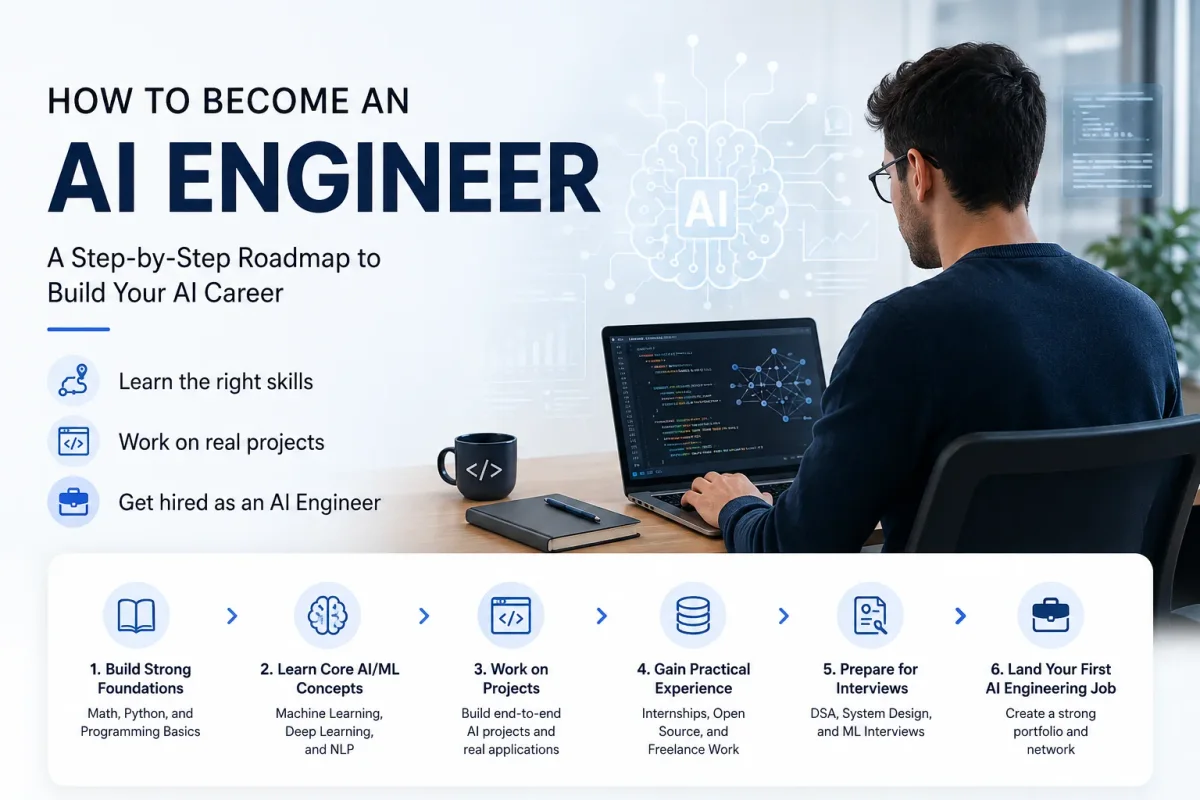
Becoming an AI engineer can look confusing from the outside. New models, frameworks, vector databases, agents, cloud services, and AI tools appear constantly. It is easy to assume that you need to learn all of them before you can start.
You don’t.
The better question is:
What skills let an engineer build, evaluate, deploy, and maintain useful AI systems?
The answer is a combination of strong programming, software engineering, machine learning, deep learning, modern AI systems, and production skills.
A practical progression looks like this:
Programming
   ↓
DSA + Problem Solving
   ↓
Git + Linux + SQL
   ↓
Software Engineering
   ↓
Math + Statistics
   ↓
Machine Learning
   ↓
Deep Learning
   ↓
LLMs + Transformers
   ↓
RAG + AI Applications
   ↓
Evaluation
   ↓
Deployment
   ↓
System Design
   ↓
Projects + Portfolio
   ↓
Internships + Interviews
You should not treat this as a list that must be completed before you build anything. Use projects to connect the stages.
For the broader role definition, see What Is an AI Engineer?. For the complete skill stack, see AI Engineer Skills.
What Does an AI Engineer Do?
An AI engineer builds software that uses artificial intelligence to solve practical problems.
The role may involve:
- machine learning
- deep learning
- LLM applications
- retrieval systems
- AI agents and tool use
- backend APIs
- data pipelines
- evaluation
- deployment
- monitoring
- system design
A production AI application might look like:
User
 ↓
Frontend
 ↓
Backend API
 ↓
AI Workflow
 ├── Model
 ├── Retrieval
 └── Tools
 ↓
Database
 ↓
Response
The model is only one part of the system.
That is why software engineering matters so much in AI.
Step 1 — Learn Programming
Python should become your primary language for most AI engineering work.
Learn:
- variables and data types
- conditions and loops
- functions
- modules and packages
- exceptions
- file handling
- comprehensions
- iterators and generators
- object-oriented programming
- type hints
- debugging
- testing
- virtual environments
Do not stop at syntax. Learn how to organize a real application, read documentation, use packages, write tests, and diagnose failures.
The goal is simple:
You should be able to open an empty editor and build a small Python application without following a tutorial line by line.
C++ is also valuable for DSA, performance, and systems fundamentals.
Step 2 — Build Problem-Solving Skills
Learn data structures and algorithms:
- arrays
- strings
- hash maps
- linked lists
- stacks
- queues
- trees
- heaps
- graphs
Then practice:
- binary search
- two pointers
- sliding window
- recursion
- backtracking
- greedy algorithms
- dynamic programming
- graph traversal
The objective is not to become a competitive-programming specialist.
The objective is to become comfortable breaking unfamiliar problems into smaller pieces.
Use the DSA Mastery roadmap and Interviews roadmap for structured practice.
Step 3 — Learn Git and Linux
Learn Git well enough for normal development:
- commits
- branches
- merges
- pull requests
- conflict resolution
- releases
Become comfortable with Linux and the command line:
- filesystems
- permissions
- processes
- environment variables
- SSH
- logs
- package management
- basic networking
Useful tools include:
git
curl
grep
find
ps
top
ssh
These are everyday engineering skills, not optional extras.
Step 4 — Learn SQL and Databases
AI applications still need ordinary software infrastructure.
You may store:
- users
- documents
- metadata
- conversations
- permissions
- feedback
- logs
- evaluation results
Learn SQL:
- SELECT
- WHERE
- JOIN
- GROUP BY
- aggregation
- subqueries
- CTEs
- window functions
- indexes
- transactions
Then learn relational database concepts such as primary keys, foreign keys, constraints, normalization, isolation, and consistency.
PostgreSQL is an excellent database to learn deeply.
Step 5 — Learn Software Engineering
This is where many aspiring AI engineers are weak.
A model in a notebook is not a product.
Learn:
- HTTP
- REST APIs
- backend development
- authentication
- authorization
- validation
- testing
- logging
- caching
- error handling
- Docker
- CI/CD
Think in systems:
Request
 ↓
Validation
 ↓
Business Logic
 ↓
AI Service
 ↓
Database / External Service
 ↓
Response
The Software Engineer roadmap is useful for building this foundation.
Step 6 — Learn Mathematics and Statistics
You do not need research-level mathematics before starting AI engineering.
Focus on:
Linear Algebra
- vectors
- matrices
- dot products
- matrix multiplication
- norms
- transformations
Probability
- distributions
- conditional probability
- expectation
- variance
- Bayes’ theorem
Statistics
- sampling
- distributions
- correlation
- regression
- confidence intervals
- experiment design
Calculus
- derivatives
- gradients
- chain rule
- optimization
The goal is understanding, not memorizing formulas.
Step 7 — Learn Classical Machine Learning
Before jumping directly into LLMs, learn traditional ML.
Understand:
- linear regression
- logistic regression
- decision trees
- random forests
- gradient boosting
- clustering
- PCA
More importantly, understand:
- train/validation/test sets
- overfitting
- underfitting
- regularization
- feature engineering
- cross-validation
- data leakage
- class imbalance
- model selection
- evaluation
A simple ML model is sometimes a better engineering solution than a large generative model.
Start with the Machine Learning guide.
Step 8 — Build ML Projects
Do not stay in course mode.
Start with projects such as:
Beginner
- house price prediction
- spam classification
- student performance prediction
Intermediate
- customer churn prediction
- recommendation system
- fraud detection
- demand forecasting
Use this workflow:
Problem
 ↓
Data
 ↓
Preprocessing
 ↓
Baseline
 ↓
Model
 ↓
Evaluation
 ↓
Error Analysis
The House Price Prediction project is an example of this foundation.
Step 9 — Learn Deep Learning
Once classical ML is comfortable, move to neural networks.
Learn:
- tensors
- layers
- weights
- activation functions
- loss functions
- forward propagation
- backpropagation
- gradients
- optimizers
- regularization
Understand:
- CNNs
- RNNs
- LSTMs
- attention
- transformers
Learn PyTorch well enough to build, train, evaluate, save, and debug models.
Continue with the Deep Learning guide.
Step 10 — Learn Transformers and LLMs
Modern AI engineering increasingly involves foundation models.
Learn:
- tokenization
- embeddings
- attention
- transformer architecture
- context windows
- inference
- sampling
- structured outputs
- tool calling
Then learn practical LLM engineering:
- model APIs
- prompt design
- model selection
- streaming
- latency
- token usage
- cost
Do not build your skills around a single provider. Learn concepts that transfer.
See the LLMs guide.
Step 11 — Learn Embeddings and Semantic Search
Embeddings are central to many AI applications.
Text
 ↓
Embedding Model
 ↓
Vector
Then:
Query
 ↓
Embedding
 ↓
Similarity Search
 ↓
Relevant Information
Learn:
- embedding models
- vector similarity
- cosine similarity
- vector indexes
- metadata filtering
- semantic search
These concepts lead directly into RAG.
Step 12 — Learn RAG
Retrieval-augmented generation combines retrieval with generation.
Basic architecture:
Documents
 ↓
Chunking
 ↓
Embeddings
 ↓
Vector Store
At query time:
Question
 ↓
Retriever
 ↓
Relevant Context
 ↓
LLM
 ↓
Answer
A serious RAG system also needs:
- document ingestion
- metadata
- retrieval evaluation
- reranking
- citations
- access control
- failure handling
- monitoring
Build one yourself rather than only watching demonstrations.
Your AI Research Assistant project is a good example of the direction to take.
Step 13 — Learn AI Agents and Tool Use
Some applications need an AI model to interact with tools.
Examples:
- search
- databases
- APIs
- calculators
- code execution
- internal systems
Learn:
- tool schemas
- function calling
- state
- retries
- timeouts
- validation
- permissions
- human approval
A safe architecture is:
User
 ↓
LLM
 ↓
Tool Decision
 ↓
Authorization
 ↓
Validated Tool Call
 ↓
Tool Result
 ↓
LLM
 ↓
Response
The model should never be your security boundary.
Step 14 — Learn AI Evaluation
A working demo does not prove an AI system works reliably.
Build evaluation datasets.
Measure:
- correctness
- relevance
- groundedness
- citation quality
- retrieval quality
- tool-call accuracy
- latency
- cost
Use:
Evaluation Dataset
       ↓
System
       ↓
Metrics
       ↓
Failure Analysis
       ↓
Improvement
       ↓
Regression Test
Repeat the evaluation when you change the model, prompt, retrieval system, chunking, reranking, or tools.
This is one of the clearest differences between a prototype and an engineered AI system.
Step 15 — Learn AI Application Engineering
Now connect your AI skills with normal software.
A practical architecture might be:
Frontend
 ↓
Backend API
 ↓
AI Workflow
 ├── Model
 ├── Retrieval
 └── Tools
 ↓
Database
Learn a backend framework such as FastAPI and become comfortable with:
- request validation
- authentication
- authorization
- streaming
- background jobs
- rate limiting
- errors
Your AI application should be structured like reliable software.
Step 16 — Learn Docker and Deployment
Move beyond localhost.
Learn:
- Docker
- Docker Compose
- environment variables
- secrets
- HTTPS
- cloud basics
- deployment
- health checks
Use this progression:
Local
 ↓
Docker
 ↓
Cloud
 ↓
Monitoring
Do not introduce Kubernetes until you have a real reason to need it.
Step 17 — Learn MLOps and LLMOps
As systems grow, reproducibility becomes important.
Learn:
- experiment tracking
- model versioning
- data versioning
- CI/CD
- deployment
- monitoring
- rollback
- automated evaluation
For LLM systems, also track:
- model versions
- prompt versions
- retrieval configuration
- token usage
- latency
- cost
- quality metrics
You should be able to identify what changed between a good version and a bad version.
Step 18 — Learn Observability
A production AI system needs useful visibility.
Track:
Request ID
Model
Latency
Token Usage
Retrieved Context
Tool Calls
Errors
Evaluation Result
Monitor:
- latency
- error rate
- throughput
- cost
- retrieval failures
- model failures
Avoid logging unnecessary sensitive user information.
Step 19 — Learn Security
AI systems can introduce new attack surfaces.
Learn:
- authentication
- authorization
- secrets management
- input validation
- rate limiting
- secure file handling
- prompt injection
- data leakage
- tool permissions
A good pattern is:
User Input
 ↓
Validation
 ↓
AI
 ↓
Authorization
 ↓
Action
Security must be enforced by application code, not by hoping the model follows instructions.
Step 20 — Learn System Design
Once you can build individual applications, learn to reason about systems.
Practice designing:
- recommendation systems
- semantic search
- RAG platforms
- AI assistants
- document-processing systems
- model-serving services
Use:
Requirements
 ↓
Scale
 ↓
Data
 ↓
Architecture
 ↓
Model
 ↓
Serving
 ↓
Evaluation
 ↓
Monitoring
Ask:
- What happens as traffic grows?
- How do we control cost?
- What happens if the model fails?
- What can be cached?
- How are retries handled?
- How is private data protected?
- How is quality measured?
Step 21 — Build a Serious Portfolio
Show progression instead of collecting shallow demos.
A useful sequence is:
Classical ML
     ↓
Deep Learning
     ↓
LLM / RAG
     ↓
Production AI Application
For example:
- House Price Prediction
- Image Classification
- RAG Document Assistant
- AI Research Assistant
- A deployed AI application with evaluation and monitoring
Then take at least one project through:
Prototype
 ↓
API
 ↓
Database
 ↓
Evaluation
 ↓
Docker
 ↓
Deployment
 ↓
Monitoring
The AI Projects guide and Projects hub can help you choose what to build next.
Step 22 — Build Your GitHub Portfolio
For serious projects, include:
- README
- architecture diagram
- setup instructions
- screenshots or demo
- tests
- evaluation results
- limitations
- future improvements
Be able to explain every major technical decision.
A smaller portfolio of strong projects is better than dozens of tutorial copies.
Step 23 — Prepare for Internships
You do not need to know everything before applying.
Once you have solid fundamentals and a few serious projects, start looking for internships.
Prioritize:
- programming
- DSA
- ML fundamentals
- software engineering
- projects
- communication
Use the Internships roadmap for the application process.
Step 24 — Prepare for Interviews
AI engineering interviews can combine:
Coding
- arrays
- strings
- trees
- graphs
- dynamic programming
Machine Learning
- overfitting
- regularization
- metrics
- feature engineering
- leakage
- cross-validation
Deep Learning
- backpropagation
- optimization
- CNNs
- transformers
LLMs
- attention
- embeddings
- RAG
- evaluation
- tool use
System Design
- APIs
- databases
- caching
- queues
- model serving
- reliability
Projects
Be ready to explain:
- why you built it
- how it works
- what failed
- what you measured
- what you would change
Use the Interviews roadmap.
Step 25 — Know When You’re Job-Ready
You do not need to know everything.
You should be able to:
- write Python comfortably
- solve common programming problems
- use Git and Linux
- work with SQL
- understand ML fundamentals
- build a deep learning project
- use LLMs appropriately
- build a RAG system
- expose an AI system through an API
- deploy an application
- evaluate AI behavior
- explain system trade-offs
If you can do these things independently, you have real evidence of AI engineering ability.
Common Mistakes
Trying to Learn Every New Tool
The ecosystem changes too quickly.
Learn concepts first.
Skipping Software Engineering
A model in a notebook is not a production application.
Jumping Straight to Agents
Learn model APIs, tool use, retrieval, and evaluation before building highly autonomous systems.
Building Only Chatbots
A basic chatbot does not demonstrate much engineering depth.
Add real data, retrieval, evaluation, authentication, APIs, or other constraints.
Ignoring Evaluation
A demo can look impressive while producing unreliable results.
Measure it.
Copying Tutorials
Use tutorials to learn.
Then rebuild the project yourself and change the requirements.
Waiting Until You Feel Ready
You become ready partly by building and applying.
How Long Does It Take?
There is no universal timeline.
A beginner must first build programming and mathematical foundations.
Someone who already knows software engineering can move much faster into ML and AI systems.
Measure progress by capability rather than months.
Early stage
You can write programs and train basic models.
Developing stage
You can build and deploy AI applications.
Job-ready stage
You can independently design, build, evaluate, deploy, and explain an AI system.
That is a much more useful definition of readiness.
A Practical Learning Direction
A realistic sequence is:
Foundation
Python + DSA + Git + Linux + SQL
            ↓
Machine Learning
            ↓
Deep Learning
            ↓
Transformers + LLMs
            ↓
RAG + AI Applications
            ↓
Evaluation + Backend
            ↓
Docker + Deployment
            ↓
System Design
            ↓
Portfolio + Interviews
The stages can overlap.
Practice DSA while learning ML.
Build projects while learning LLMs.
Deploy projects while studying system design.
The Learning Loop That Actually Works
Do not organize your progress around finishing courses.
Use:
Learn
 ↓
Build
 ↓
Break
 ↓
Debug
 ↓
Measure
 ↓
Improve
 ↓
Deploy
 ↓
Explain
The debugging stage is especially valuable.
It forces you to understand what is actually happening rather than just reproducing a tutorial.
Final Checklist
Before calling yourself job-ready, ask:
Programming
- Can I build Python applications independently?
- Can I debug my own code?
Software Engineering
- Can I build an API?
- Can I work with a database?
- Can I write tests?
- Can I use Git confidently?
Machine Learning
- Can I build and evaluate an ML model?
- Can I recognize overfitting and data leakage?
Deep Learning
- Can I explain backpropagation?
- Can I train and debug a PyTorch model?
LLMs
- Do I understand attention and transformers?
- Can I build an LLM application?
RAG
- Can I implement retrieval?
- Can I evaluate retrieval quality?
Production
- Can I deploy an AI application?
- Can I monitor it?
- Can I explain its failure modes?
Career
- Can I explain my projects deeply?
- Can I solve common interview problems?
- Can I communicate technical decisions clearly?
If most answers are yes, you are moving toward real AI engineering capability.
Final Thoughts
There is no shortcut to becoming an AI engineer.
The shortcut people hope to find is usually a new framework, a new course, or a new model.
The real shortcut is building the right foundation and avoiding unnecessary distractions.
Learn programming.
Become a strong software engineer.
Understand machine learning.
Learn deep learning and transformers.
Build useful LLM applications.
Learn retrieval and evaluation.
Deploy what you build.
Monitor it.
Secure it.
Then learn how to design larger systems.
The goal is not to become the person who knows the most AI tools.
It is to become the person who can take an unclear problem and turn it into a reliable working system.
That is what makes the skill valuable.
Your Next Step
Use the AI Engineer Roadmap as your structured path.
Then identify your weakest capability and build around it:
Weak at ML
→ Build an ML project

Weak at Deep Learning
→ Build a PyTorch project

Weak at LLMs
→ Build a RAG application

Weak at Deployment
→ Deploy an existing AI project

Weak at System Design
→ Design and document the architecture
You do not become an AI engineer by learning everything first.
You become one by repeatedly turning knowledge into working systems.
Learn → Build → Evaluate → Deploy → Improve.
Continue the path
Keep building from here
How to Become an ML Engineer: A Practical Roadmap for 2026
A practical ML engineer roadmap covering Python, math, machine learning, software engineering, projects, deployment, and career preparation.
ML Engineer vs AI Engineer: What's the Difference?
Machine Learning Engineer vs AI Engineer explained clearly: responsibilities, skills, tools, projects, career paths, and how to choose the right role.
AI Engineer Roadmap
A practical AI engineer roadmap covering software engineering, math, ML, deep learning, LLMs, deployment, evaluation, and career preparation.
AI Research Assistant
Build an LLM research assistant with document search, evidence retrieval, grounded summaries, source comparison, and citations.
Hands-On Machine Learning
A practical reference for machine learning with Python, scikit-learn, deep learning, and modern ML workflows.
Practical Deep Learning for Coders
A practical course centered on building and training deep learning systems with a strong implementation focus.